Key Insights
Top HRM Models
The main HRM models are crucial for HR departments because they allow the identification of the most suitable framework in order to align people management with the goals of the organisation. They consist of the Harvard Model, Michigan Model, Guest Model, Warwick Model, 5P Model, and Ulrich Model, which are all recognised frameworks.
Importance of HRM Models
Models in HRM are very important for the consistency in the organisation, employee engagement and HR strategies that are in line with the long-term business success. Besides, these models facilitate HR departments in making structured, evidence-based decisions, which, in turn, improves the overall performance of the organisation.
What Are HRM Models?
HRM models are the ones that specify the way through which an organisation should consider and treat its people by putting together the principles, processes, and outcomes that are clearly defined. In this way, these frameworks supply the HR teams with an organised way to coordinate the employee management with the business requirements. At the same time, they are helping the companies to realise the connection between HR practices, employees’ performance and long-term strategic goals.
Moreover, HRM models are giving the organisations an indication of the way the decisions on hiring, training, engaging, and managing performance should be taken. Applying these models, businesses can eliminate inconsistencies, in turn, making their people practices fair and transparent. Besides this, they also allow HR to create policies that are advantageous for both the employee’s progress and the organisation’s growth. In short, HRM models are the building blocks of effective HR strategies that can be applied to various industries.
Top 6 HRM Models
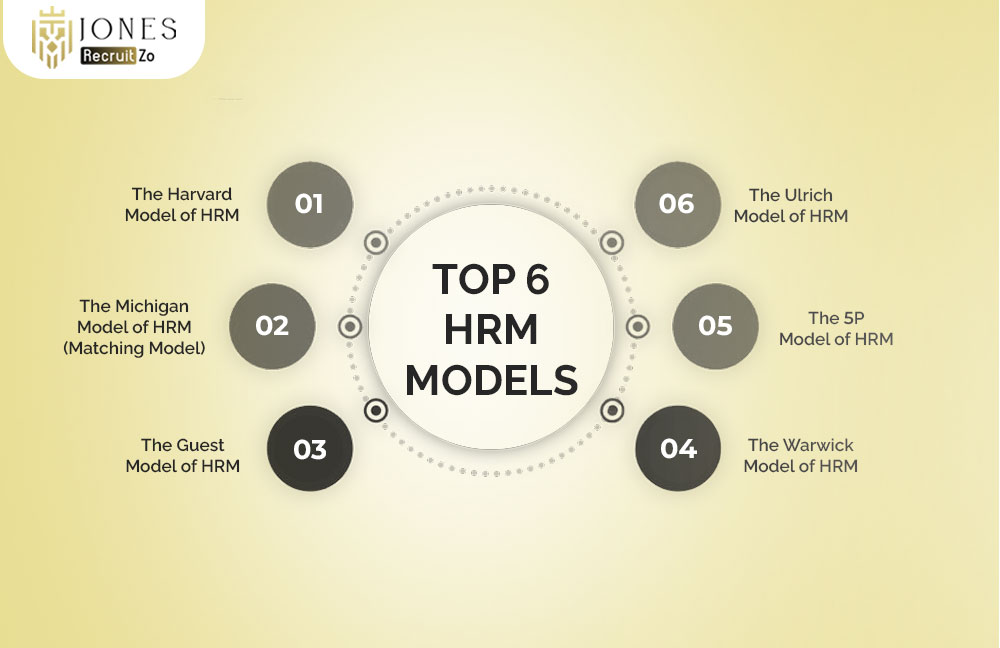
These HRM models offer different perspectives on how organisations can manage talent, shape culture, and drive performance. They help HR professionals choose the right framework based on business structure, goals, and workforce needs.
The Harvard Model of HRM
HRM by the Harvard Model provides a wide-ranging perspective that sees HR as the driving force behind the company’s success through commitment, competence, congruency and efficient cost management. By the model it is made clear that HR is not the only department that influences HR decisions but also other stakeholders and that the company should manage the whole people aspect from a single point of view.
The model devised by Beer et al. at Harvard University drew on four main areas of HR policy: employee participation, human resource movement, rewards, and working conditions. Their contention was that organisations would gain better performance in the long run if they did not only consider the needs of the stakeholders and situational factors but also balanced them with these elements. The Harvard Model is the preferred choice for large organisations when it comes to strategic HR planning.
The Michigan Model of HRM (Matching Model)
According to the Michigan Model, HR practices must always be in line with the company’s strategy. It provides a straightforward way to integrate recruitment, performance management, rewards, and development with business goals.
The model built by Fombrun, Tichy, and Devanna laid emphasis on four functions of human resources: hiring, evaluation, compensation, and training.
It is the very doctrine of the Michigan Model that people should be regarded as the firm’s assets whose performance has a direct impact on profits. The model is adopted by many firms that place a high value on efficiency, performance measurement, and accountability.
The Guest Model of HRM
The Guest Model of HRM emphasises achieving employee loyalty, flexibility, quality, and strategic alignment through carefully planned HR interventions. It provides a results-driven approach linking HR activities to measurable organisational outcomes according to the conventions of contemporary management.
This model, created by David Guest, emphasises the crucial role of high-quality HR practices in producing excellent results. It presents six major HR components: HR strategy, HR practices, HR outcomes, behavioural outcomes, performance outcomes, and financial outcomes. The Guest Model is particularly beneficial for organisations targeting higher employee involvement and continued productivity in the long run.
The Warwick Model of HRM
The Warwick Model depicts the interaction between internal and external factors in determining HR strategies and the resultant HR outcomes. It gives HR personnel an acute insight into how the company’s context influences the management of its people.
Developed by scholars from the University of Warwick, the model identifies five significant elements: outer context, inner context, business strategy, HR strategy, and HR outcomes. Besides these, it helps organisations in analysing the impact of economic, political, competitive, and cultural factors on HR decisions. The Warwick Model is particularly useful for organisations going through a change process or experiencing market uncertainty.
The 5P Model of HRM
The 5P Model is a tool that depicts the incorporation of the five P’s into one single strategy – purpose, principles, processes, people, and performance. It gives the flexibility to the companies to enact HR practices that are in line and harmonious across the entire organisation.
This model, developed by Schuler, asserts that HR systems need to be interrelated for the organisation to come out with strong performance results. Moreover, it makes HR departments emphasise their purpose and principles being in consonance with the organisational strategy while making sure that the methods are conducive to creating and retaining engaged and effective employees. The 5P Model is ideal for organisations which are envisaging and emplacing long-haul HR frameworks.
The Ulrich Model of HRM
The Ulrich Model identifies four key HR roles—strategic partner, administrative expert, employee champion, and change agent, that enable HR teams to make more effective contributions to the success of the organisation. The model redefines HR’s role as that of a strategic driver rather than a mere support function.
Developed by Dave Ulrich, the model clarifies the position of HR professionals in two camps – one supporting business leaders and another helping employees. The model further suggests transformation of HR by promoting the traits of operational efficiency, strategic alignment, and employee advocacy. The Ulrich Model has become a standard in contemporary organisations that aspire to create agile and strategic HR departments.
Why HRM Models Are Important?
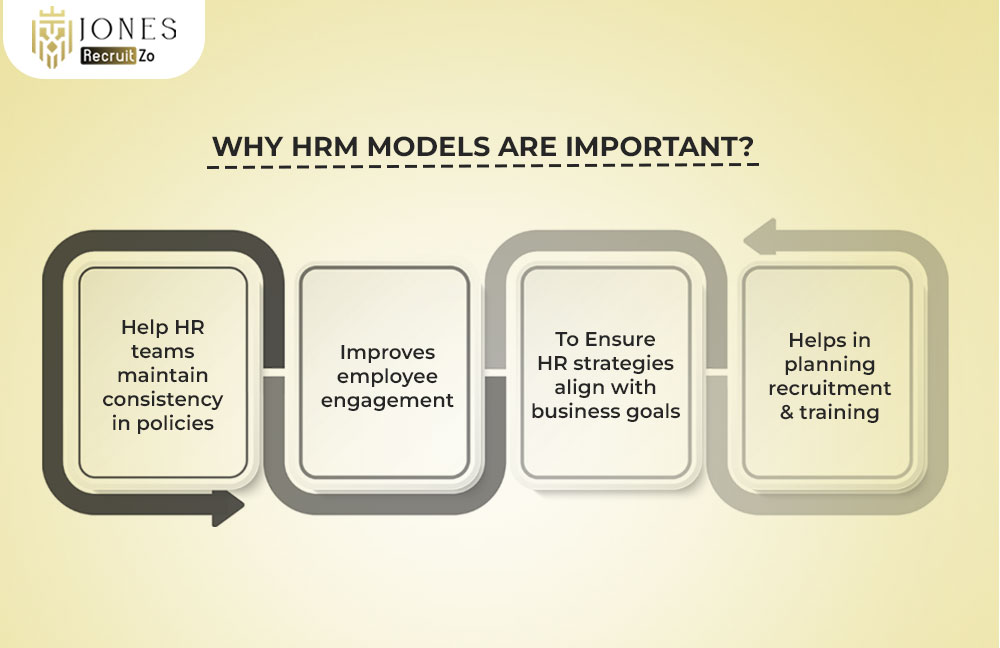
HRM models play a crucial role in helping organisations manage people with clarity, consistency, and strategic alignment. They allow HR teams to design structured processes that support both employee growth and organisational success.
Help HR teams maintain consistency in policies
Applying HRM models guarantees that the rules are the same throughout the different teams in terms of fairness and uniformity. The above-mentioned workplace is already established as transparent, and employees already know what is expected from them and what the organisational standards are. It also cuts down on misunderstandings and prevents differences in the making of decisions in the different departments, which, in turn, helps HR to keep up with its fair treatment.
Improves employee engagement
Employees working in companies that use structured models for their HR practices benefit from good communication, equal treatment and growth opportunities. They become more loyal and even more eager to work as a result. The resources of clear frameworks also assist the managers in being the consistent supporters, and thus, trust is tangentially strengthened, and employee morale is, in effect, raised.
To ensure HR strategies align with business goals
HRM models not only assist the HR teams in their determination of the policies and processes that will directly support the company’s priorities but also help them to think of HR as being more of a strategic partner and thus, being able to take better and more informed decisions regarding the workforce and overall HR planning. Furthermore, the chances are high that every HR initiative will contribute to the growth in the long run and thus, the overall performance of the organization.
Helps in planning recruitment & training
The presence of defined frameworks enables the HR teams to spot the talents that the organisations require and consequently set up the recruitment and training plan. This does not only result in the acquiring of better talents, the development of skills and the readiness of the workforce for the long term, but it also helps the HRM models to identify and focus on the critical roles and the training requirements, and thus, the effective use of resources is ensured.
How to Select the Right HRM Model?
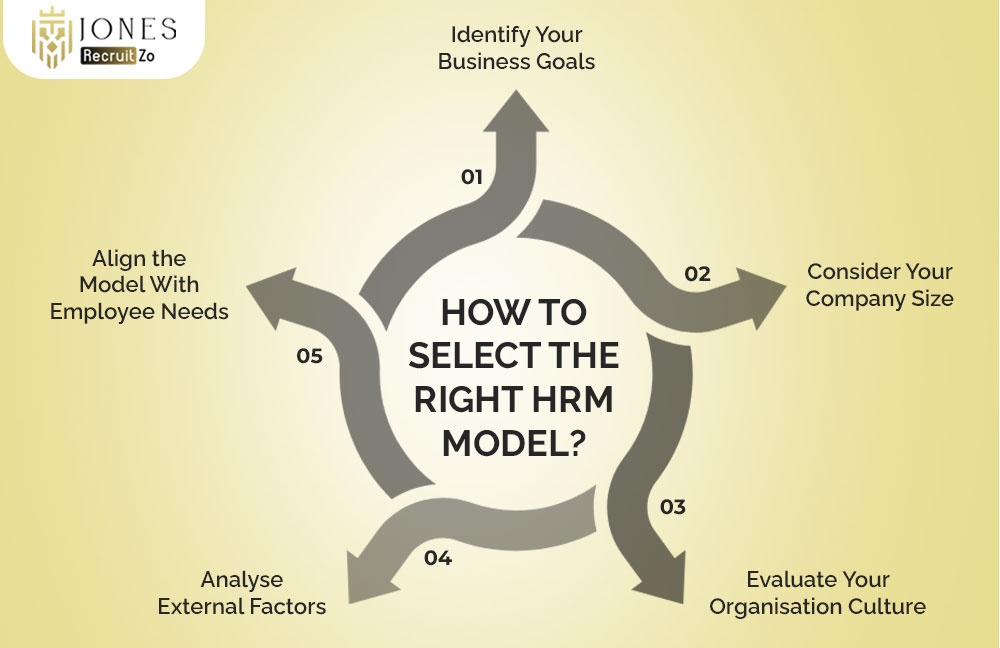
Selecting the right HRM model requires an understanding of organisational needs, external factors, and employee expectations. A suitable model ensures that HR strategies support business goals while maintaining employee satisfaction.
Identify Your Business Goals
Start by analysing what the organisation aims to achieve growth, efficiency, innovation, or stability. The model of HRM that is most suitable should be the one that most directly supports these objectives. A clearly defined set of business priorities will, besides allowing HR to choose a model that aligns with long-term planning and decision-making, facilitate the establishment of an HR-owned sector whose contribution is directly related to the measuring of outcomes.
Consider Your Company Size
A big company might go for an all-encompassing model like Harvard or Warwick, while a small company would probably go for a less complicated approach like Michigan’s or the 5P model. The size of the firm dictates the HR processes involved, the availability of resources, and the structure of the management. It is always prudent to select the type of model that goes along with the realities of the situation in order to be able to work more effectively. Besides, it keeps the policy implementation from becoming too complicated.
Evaluate Your Organisation Culture
Company culture will be a major factor in determining the HRM model that will be suitable for the company. The prevailing culture in such companies as consumer and producers-oriented will, more often than not, decide which HR models to use, such as those concentrating on measurement, and efficiency might be the choice of the performance driven cultures. The model selection that mirrors the core values of the organisation will be a sure way of achieving employee congruence and behaviour. Moreover, it will be the best way to guarantee that the HR policies are smoothly entwined with the daily practices at the workplace.
Analyse External Factors
A number of things, such as the market, economic realities, and competition, dictate what the HR department will do. In such a case, it would be quite reasonable for HR departments to choose a model that would support their adaptability and openness to change. An external unstable situation is capable of determining the flow of personnel and their corresponding skills and, thus, the availability of talents. A model that takes into account these fluctuations leads to a more inventive approach to manpower and its planning.
Align the Model With Employee Needs
Understanding employee expectations ensures that the chosen model supports engagement and long-term retention. Employee centred models lead to more supportive and productive workplaces. By addressing factors such as career growth, work culture, and communication style, HR teams can create a more positive employee experience. This alignment also boosts loyalty and reduces turnover.
FAQ
1) What are HRM models?
HRM models are basically organised layouts that depict how the various human resources of an organisation are to be managed. These models specify the underlying principles, the processes and the strategies that would be used in carrying out HR functions like recruitment, training, performance appraisal and finally, the engagement of employees. They also enable the HR people to be on the same page as the organisation’s direction concerning people and thus provide everywhere excellent and uniform management of employees.
2) What are the different types of HRM models?
There are various types of HRM models that have gained prominence and acceptance in the market. The most commonly used ones include the Harvard Model, the Michigan (Matching) Model, the Guest Model, the Warwick Model, the 5P Model and finally, the Ulrich Model. Every model has its own viewpoint regarding the management of personnel – some lay stress on the strategic alignment, while others on the employee’s growth and development, engagement or HR roles.
3) Why are HRM models important?
HRM models play a crucial role, as they set a blueprint for the design and implementation of HR practices. Moreover, they are a great help in keeping up with the changes in HR policy, maintaining consistency, giving support to employee engagement and ensuring that HR practices are in sync with the business strategy. The use of structured models helps organisations to draft better policies, make improved and more valid decisions, and elevate the productivity and performance of the entire workforce.
4) How to Select the Right HRM Model?
When selecting the appropriate HRM model, organisations should initially take into account their business objectives, the size of the company and the corporate culture. Besides, external elements like market trends and availability of manpower should also be factored in. The HR management teams should be sure that the model they have chosen fits the present workforce and at the same time facilitates the long-term growth of the organisation.