Key Insights
Difference Between International HRM and Domestic HRM
The main difference between international HRM and domestic HRM is that the former manages human resources through different countries, requiring coping with diverse cultures, global workforce architectures, and very complicated legal matters. The latter, however, deals with one country’s geography only, and thus one legal and cultural situation offers no obstacles.
Key Activities in Domestic HRM
Domestic HRM can be viewed as including a triad of activities: recruitment, onboarding, payroll, and performance reviews. The whole process is such that employees are well-managed to contribute locally, plus it is ensured that there is compliance with the national employment laws.
Key Activities in International HRM
International HRM runs the whole world; thus, among others, it introduces expatriate staffing, cross-cultural training, and international compensation design. The emphasis is on making global HR practices that are in congruence with business strategies and at the same time keeping them uniform across countries.
What is Domestic Human Resource Management (HRM)?
Domestic HRM indicates that the management of employees is confined to the territory of a single country. The management is done in accordance with the local labour regulations and the company policies for hiring, training and developing the staff. The main aim is to keep a productive and engaged workforce that helps the organisation in achieving its short- and long-term goals in the domestic market. Domestic HRM is generally easier to manage because it is based on the same set of employment laws has a common language, and the cultural understanding is so close that it makes HR functions smoother and more predictable.
Key Activities in Domestic HRM
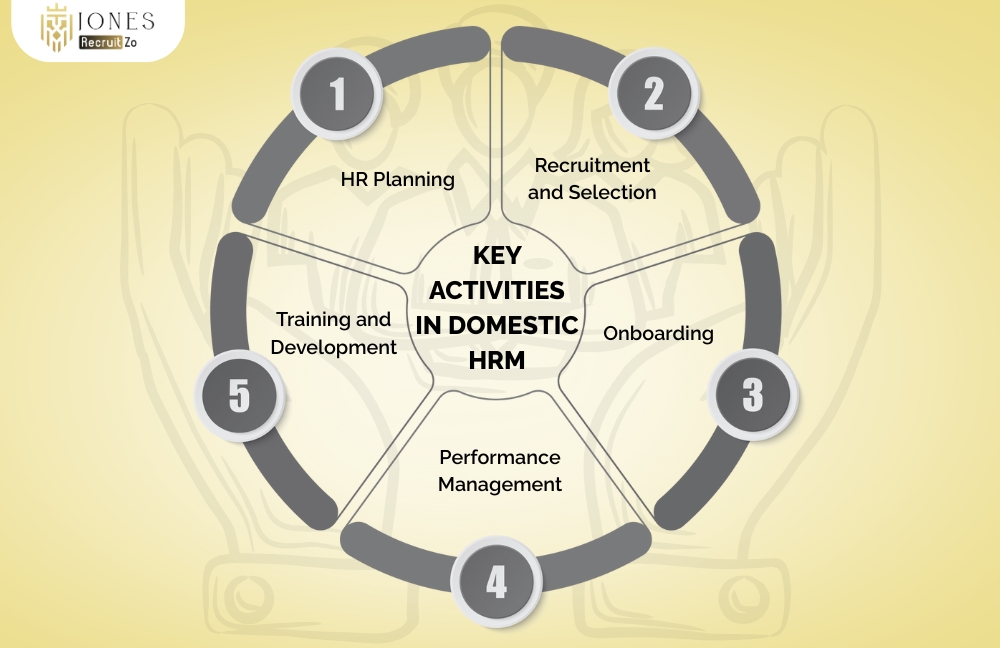
Domestic HRM includes essential activities that ensure smooth people management within the organisation.
HR Planning
HR planning is the process of evaluating the existing workforce, estimating the future requirements, and giving the company the right number of employees with the right skills to achieve the business goals efficiently, thus helping to reduce the number of talent gaps and avoiding the situation of having the workforce suddenly shrink.
Recruitment and Selection
Recruitment is the whole process of attracting and selecting the best-qualified candidates for the particular roles in the country. Domestic recruitment mostly uses standardised processes that are in line with the local employment laws and the company’s needs, while at the same time it increasing the employer’s profile and getting long-term, dedicated employees.
Onboarding
Onboarding is the process of introducing new recruits to the company’s policies, culture, and expectations. This procedure enables the workers to get accustomed to their positions without any difficulty, and it increases the productivity of the early stages, which in turn leads to the retention and satisfaction of the workers.
Performance Management
Domestic HRM’s performance management system is the one that assesses the employees’ achievements and the areas that need improvement. It does this by aligning the individual performance with the organisational targets through the regular reviews and feedback, thus inviting accountability and motivating the employees to perform better.
Training and Development
Training is a sure way to provide the workers with the skills and knowledge required for the efficient performance of their duties. In addition, the development schemes can be utilised to prepare people for their career advancement and future leadership opportunities, whereas constant training ensures the workforce keeps pace with the industry’s changing standards.
What is International Human Resource Management (IHRM)?
International Human Resource Management (IHRM) is a workforce management that operates across various nations. It involves various HRM practices for domestic HRM by taking into consideration the different laws, cultures, and business practices. The aim is to keep HR policies in sync worldwide while making them appropriate for international settings.
IHRM operates by HR professionals dealing with expats, locals, and international coworkers all at once, thus ensuring communication among them irrespective of the fact that they are located in different areas, have different working hours, and practice different work styles. It also emphasises the creation of a single global culture that is in harmony with the company’s values.
Key Activities in International HRM
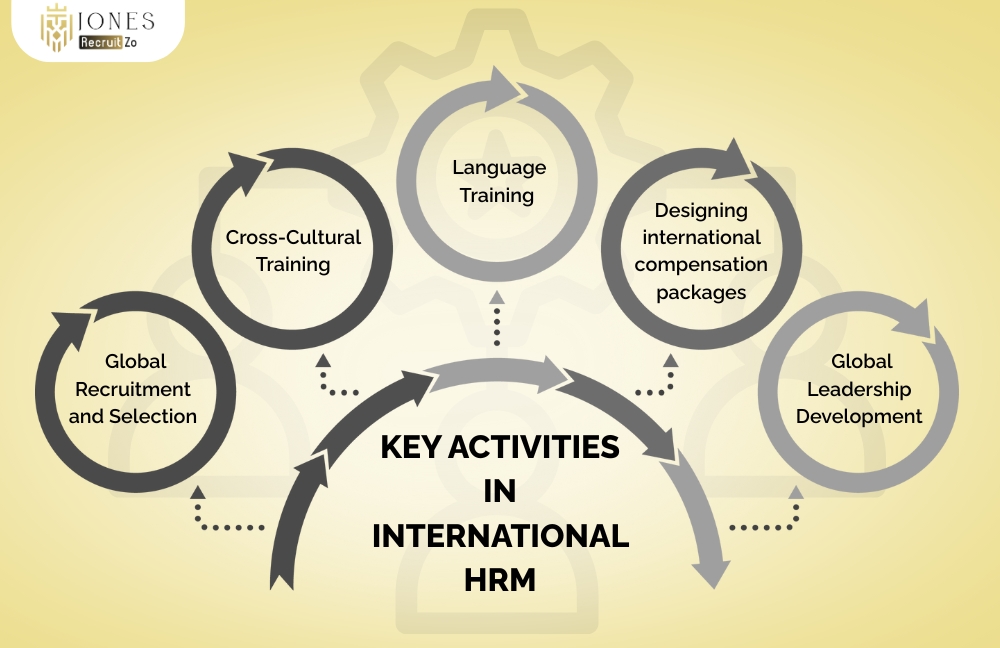
International HRM focuses on activities that address global workforce complexities and cultural diversity, ensuring that HR practices align with both local and international business needs.
Global Recruitment and Selection
IHRM recruitment strategy consists of the process of finding candidates from various countries. The procedure has to be in accordance with the international labour standards, visa requirements, and cultural expectations so as to be fair and inclusive and at the same time to attract the very candidates who will enrich the organisation with the global perspectives that they bring.
Cross-Cultural Training
Cultural sensitivity training is given to employees who are working abroad or are part of international teams. This training helps the employees to understand and respect the different work cultures and the different communication styles and business etiquette, thus reducing misunderstandings and easing the collaboration of the employees across the borders.
Language Training
Language training is very important because global teams usually communicate in different languages. The training improves communication, teamwork, and strong ties among the staff of different countries, thus making it easier and more efficient to coordinate the work of the different countries.
Designing international compensation packages
The compensation package in IHRM consists of salaries, benefits, and allowances adjusted to local living standards and tax regulations. The package very often includes support for relocation, housing, and hardship allowances for expatriates, which leads to equitable pay and at the same time keeps the employees satisfied in all regions with regard to the pay.
Global Leadership Development
The training of leaders to handle international teams is a major concern of IHRM. Global leadership programmes develop strategic thinking, cultural intelligence, and adaptability in high-potential employees, and they become empowered to lead the success of the business in the different cultural markets.
Key Difference Between International HRM and Domestic HRM
Although both share the same objective of managing human resources effectively, their scope and approach differ significantly, especially when it comes to dealing with cultural diversity and international legal frameworks.
Legal Complexity
International HRM must comply with various national laws, whereas domestic HRM operates under just one legal system. The professionals engaged in IHRM have to keep themselves updated on ailing international rules regarding labour, taxation, and visa matters, ensuring that employee transfers are smooth while also maintaining compliance across countries.
Cultural Sensitivity
Domestic HRM is not only managing but also being operationally dependent on a fairly homogenous workforce. On the other hand, IHRM is involved with multinational workgroups which require a strong grasp of more than just different beliefs, values and working habits in order to maintain the global operations, the harmony and the productivity.
Payroll and Taxation
A payroll system in domestic HRM is subject to the taxation of a single country. In contrast, international HRM is required to manage a multi-currency payroll alongside different tax systems and international compliance standards, thus making proper financial reporting and transparency extremely important.
Compensation Structures
Compensation of HRM in the domestic market is limited to one region, whereas IHRM must stretch its pay structure flexibility by taking into account currency fluctuations, cost of living, and expatriate benefits. Thus, it guarantees global equity while being able to compete in the market.
Risk Management
International HRM is pushed to higher risks as there are political, economic and legal uncertainties on the borderline. One of the risk management strategies is crisis planning and taking international insurance coverage to protect both the company and its staff around the globe.
Employee Categories
The only category of workers in domestic HRM is those who live in the country. Expatriates, host-country nationals, and third-country nationals are the different groups of employees in IHRM. They all require different management practices and specific HR policies tailored to their needs.
Training
While domestic HRM focuses on professional and technical training, IHRM includes cross-cultural, global leadership, and international communication training to ensure global readiness. This holistic approach builds adaptability and cohesion in international teams.
Challenges in Domestic HRM
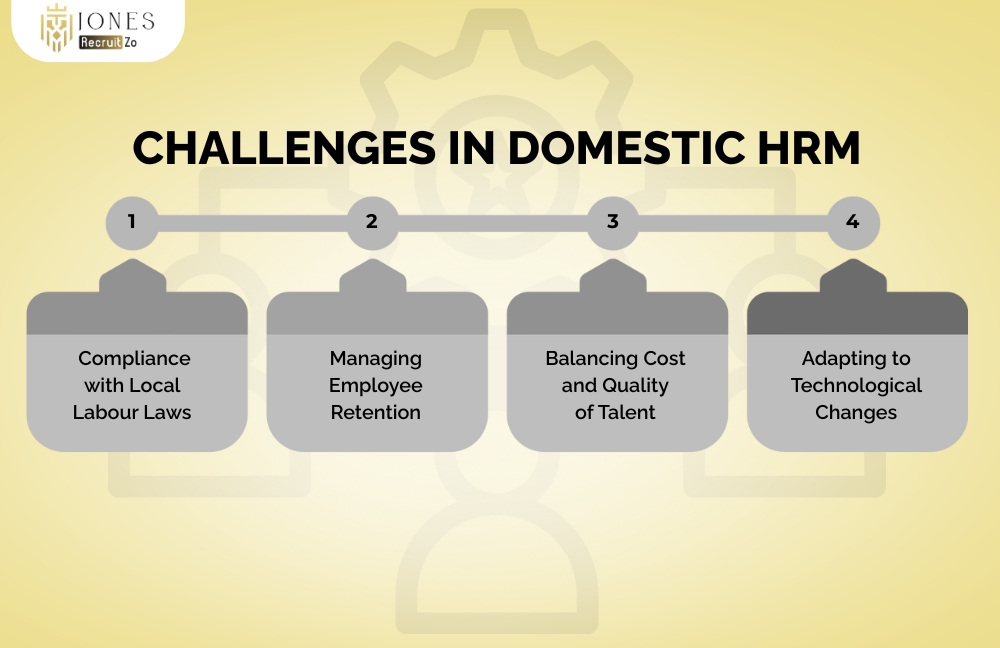
Despite operating within one country, domestic HRM faces several operational challenges that require constant attention and strategic management. These challenges influence how effectively HR teams can attract, retain, and develop their workforce.
Compliance with Local Labour Laws
It is the responsibility of the domestic HR professionals to align all HR activities with the local labour laws, wage acts, and employment standards. Any non-compliance can lead to legal actions and damage to the company’s reputation, which is why constant monitoring and updating of policies are crucial.
Managing Employee Retention
Employee turnover of a high nature is still a major concern. HR teams have to offer growth possibilities, good pay, and a thriving culture to keep the talent in a competitive market. Since employee satisfaction is a direct factor in overall productivity, organisations are reluctant to give higher salaries and create a positive culture to keep the talent in a competitive market.
Balancing Cost and Quality of Talent
Companies very often have the dilemma of whether to hire cheaper talent or to hire one that is very expensive but guarantees high-quality performance. Strategic workforce planning is essential to resolve this matter, thus helping the organisation to reduce costs while still having skilled personnel.
Adapting to Technological Changes
The digital shift in HR functions is inevitable. Domestic HR teams would have to keep pace with the latest trends in HRMS software, analytics tools, and automation technologies to be on the efficient side and to have HR operations going smoothly.
Challenges in International HRM
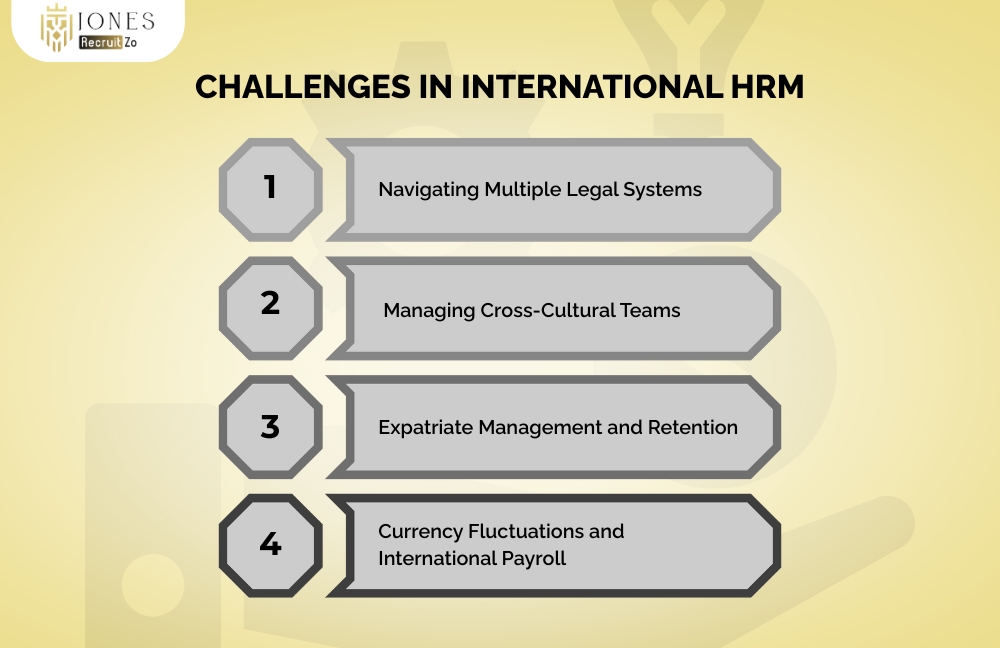
International HRM faces additional layers of complexity when managing diverse global teams. These challenges arise from legal, cultural, and financial differences that influence global HR operations.
Navigating Multiple Legal Systems
International HR professionals must deal with the different employment laws in the different countries, such as tax, immigration, and working hours, which could lead to them going out of compliance if they do not handle them correctly. It is important to keep updating HR policies to comply with local laws and keep global consistency at the same time.
Managing Cross-Cultural Teams
Having a multilingual and multi-ethnic workforce demands a lot of sensitivity and inclusivity. Mis-consideration or cultural misunderstanding can bring down productivity and hurt teamwork; thus, the need for open communication and cultural awareness becomes very important.
Expatriate Management and Retention
The management of expatriates entails providing support for moving, changing salary, and help in getting back. It is very necessary but difficult at the same time to retain skilled expatriates due to personal and cultural factors; thus, career planning and family support become essential for long-term retention.
Currency Fluctuations and International Payroll
Currency risk due to the exchange rates is a common problem that global operations face which affects the payroll budget and the uniformity of the compensation. HR has to ensure that there is financial precision and that the salary distribution among the countries is fair in order to keep the employees satisfied and trusting.
FAQ
1) What is the difference between international HRM and domestic HRM?
The difference between international HRM and domestic HRM is mainly seen in their scope and the level of complexity involved. HRM at the domestic level is restricted to a single country, whereas HRM at the international level spans the entire globe by taking into account differences in culture, legal systems and operations.
2) What are the key activities in domestic HRM?
In domestic HRM workforce planning, recruitment, onboarding, training and performance management are the main activities performed in one country. The primary concern of domestic HRM is compliance with local labour regulations and ensuring that employees remain productive.
3) What are the key activities in international HRM?
The key activities in international HRM are global recruitment, cross-cultural training, expatriate management and international compensation planning. In fact, the goal of international HRM is to have consistent HR practices while at the same time being flexible enough to cater to the requirements of the local market.
4) What are the challenges in international HRM?
The challenges faced by international HRM include managing teams from different cultures, observing the laws of different countries, and dealing with changes in currency value. Also, there is the issue of retaining expatriates and making sure that the global payroll is correct.
5) What are the challenges in domestic HRM?
One of the main issues domestic HRM has to deal with is compliance with local labour law. Besides, it has to come up with strategies for reducing employee turnover and be constantly on the alert for new technology that can be used to its advantage. Furthermore, it has to make sure that the quality of the talent hired is not compromised while still enjoying the cost savings associated with productivity.