What Are Employee Performance Metrics?
Employee performance measures are quantifiable variables that define the efficiency, quality, and contribution of the work done by different employees. They promote performance measurement and systematic KPI monitoring through providing feedback on productivity, behaviour, and output. Such performance measures also assist the leaders to know how to accurately measure performance using data-supported decision-making processes.
Why Are Employee Performance Metrics Important?
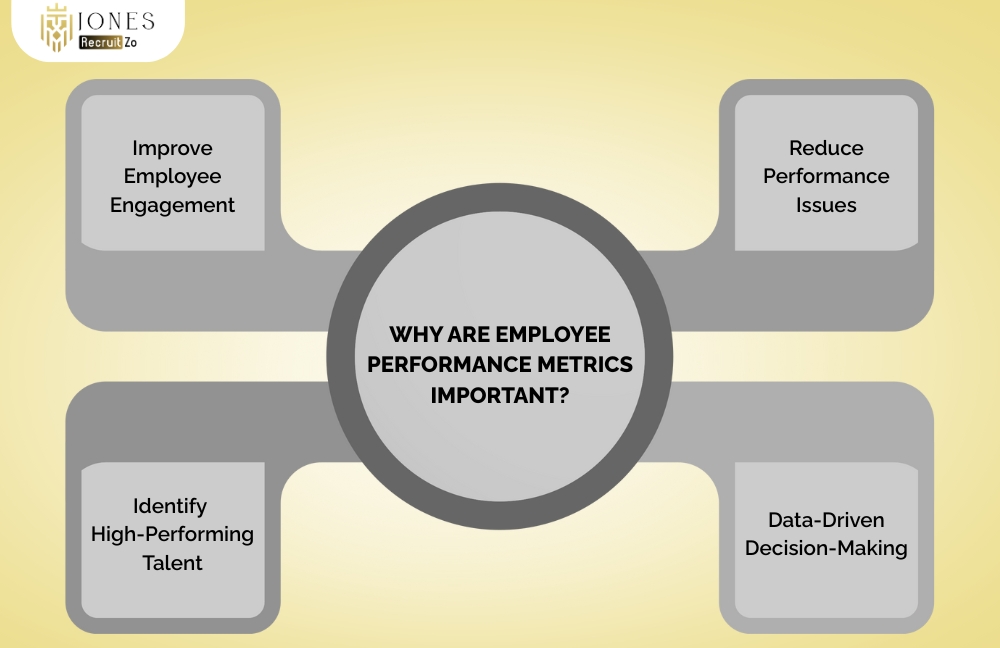
These measures enhance the performance of employees by establishing clarity, accountability, and consistency. They endorse performance measures that improve productivity metrics, teamwork, participation, and goal congruency. Effective tracking systems like employee performance evaluation measures make an organisation aware of the trends, minimise the errors, and ensure transparency of all work efficiency processes.
Improve Employee Engagement
Monitoring the performance indicators of employees assists in increasing the level of engagement by showing the positive aspects, eliminating the shortcomings, and providing rewards. Inspirational performance indicators promote motivation, ownership, and continuous improvement. Organisational structures that match the performance measurement strategy enable employees to feel more informed and more dedicated towards the accomplishment of organisational objectives in a gradual manner.
Identify High-Performing Talent
Organisational key employee performance measures are used to identify the best talent based on productivity measures, level of contribution, efficiency in work, and quality measures. A successful performance assessment can assist in building future leaders, compensating merit, and matching high achievers with development prospects. The tracking guarantees the application of correct and impartial decisions on performance ratings.
Data-Driven Decision-Making
Through the analysis of performance measures, leaders will be able to have a better understanding of trends, bottlenecks, and areas of improvement. Evidence-based employee performance assessment measures encourage proper planning and resource distribution. These specific performance indicators facilitate open decision-making and establish an operational and strategic culture in which quantifiable results drive operational and strategic conversations.
Reduce Performance Issues
Proper performance measures are essential in detecting and fixing the problem at the early stage and enhancing productivity measures and the workflow performance. They inform managers on the way to measure performance in a consistent and fair way. Clarity of performance indicators will guarantee prompt interventions, improved training, and specific support to curb repetitive mistakes and poor performance between teams.
Top 10 Employee Performance Metrics To Track
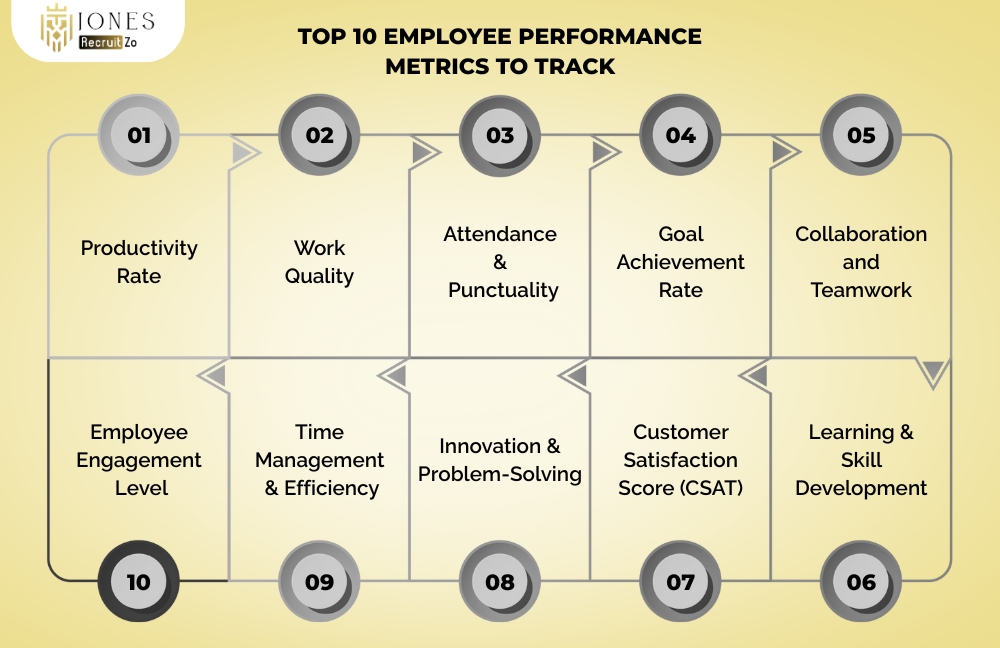
Monitoring of the correct employee performance metrics will guarantee proper performance assessment and enhanced decision-making. These structured performance indicators assist in the analysis of productivity indicators, quality indicators, the level of engagement, and work efficiency. Applying key employee performance indicators allows transparency, focused actions, and improved alignment of goals, teams, and organisational necessities.
Productivity Rate
Productivity measures evaluate the effectiveness of the workers accomplishing the tasks accomplished in the allocated time. This indicator is essential because it allows the leaders to comprehend the efficiency and improvement requirements of work. Employee performance metrics are powerful tools to track performance and provide valuable information about employee output, and therefore, it is simpler to streamline working processes and improve performance rating systems.
Work Quality
Accuracy, precision, and consistency are expressed in the quality of work. Good performance indicators enable leaders to check error rates, the standard of work to be done, and assurance. The indexing of quality measures of employees by organising employee performance measurement indexes will not only ensure that employees meet expectations but also assist the organisations in maintaing high levels of output within the departments and other customer-facing functionalities.
Attendance & Punctuality
Performance indicators that should be considered as mandatory are attendance and punctuality, as these performance indicators reflect the discipline, reliability, and commitment of the employees. These metrics of employee performance are used to detect the trends of absenteeism that affect productivity indicators and workflow efficiency. High-quality KPI monitoring would make interventions at the right time and facilitate regular performance assessment, which can be useful in coordinating the whole team.
Goal Achievement Rate
Goal achievement tracking measures goal progress against measurable performance measures. This will facilitate the proper rating of performance and will keep the employees aligned to the priorities of the organisation. The key employee performance metrics are a good measure of performance, as they are easy to understand and accountable, and the performance levels are visible so that the managers can easily steer the improvement.
Collaboration and Teamwork
This metric determines collaboration, coordination, and contribution to a team. The use of structured employee performance indicators can be used to monitor the activity in group work and collective objectives. Assessment of teamwork using performance indicators enhances coordination, improves the productivity rates, and develops high-performing teams that can facilitate organisational growth and provide a steady result.
Learning & Skill Development
This measure assesses the attendance at training courses and competency development. Monitoring using performance indicators will ensure that employees have been enhancing their abilities. The indicators of performance assist the companies to recognise the areas of development, nurture talent pools, and facilitate the long-term performance evaluation plans in line with the organisational goals.
Customer Satisfaction Score (CSAT)
CSAT is the view of customers on the quality of the service. One of the most valuable performance metrics of the customer-facing teams, it provides information on responsiveness and work efficiency. Follow-ups on CSAT by way of formal performance review would make the employees create value and provide consistent service delivery at all points of service delivery.
Innovation & Problem-Solving
The innovation metrics determine creative attitude, solution-focused mind, and capacity to cope with difficulty. Good employee performance indicators will assist in gauging initiative and responsiveness. These performance metrics help in recognising employees with strategic value, and this means that organisations can respond more promptly and establish better productivity levels by making better decisions.
Time Management & Efficiency
Time management measures the level of managing priorities by employees. Performance metrics are the sure way of evaluating work efficiency and work handling. These performance indicators are used by managers to determine delays, streamline processes, and improve the overall productivity measures of the various departments.
Employee Engagement Level
The levels of engagement depict motivation, involvement, and emotional attachment to the work. Better retention and productivity metrics are followed by monitoring engagement in terms of employee performance metrics. Such planned performance measures make organisations aware of cultural wellness, bolstering performance metrics and long-term labour security.
How to Measure Employee Performance Effectively?
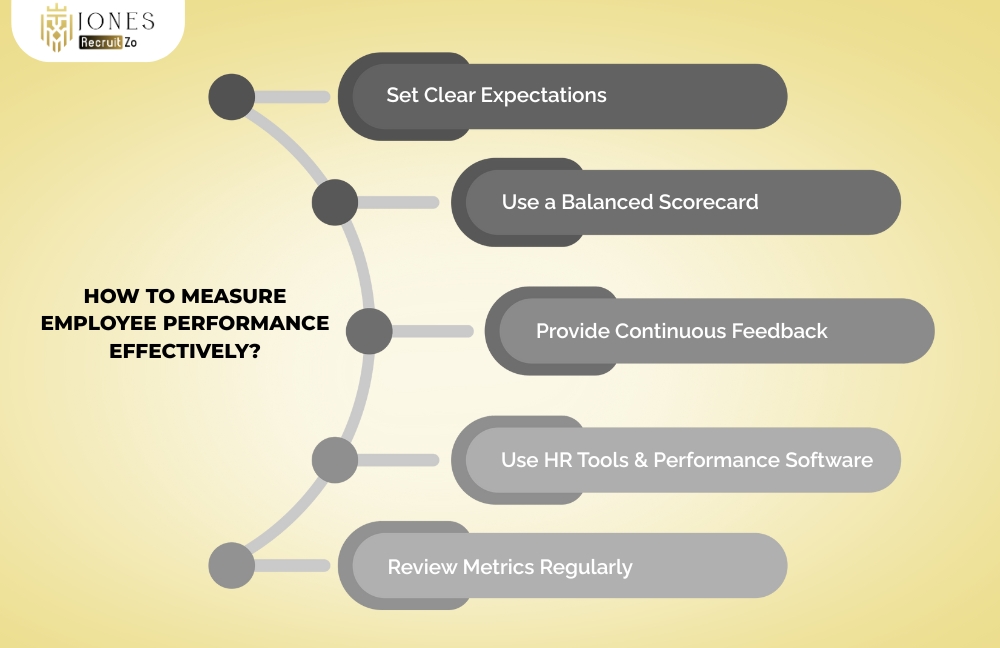
The effective method of measuring employee performance should be systematic, where a combination of performance indicators and regular review systems are combined. The organisations should focus on KPI monitoring and matching goals with clear expectations in order to make managers know how to measure performance precisely without neglecting transparency. This provides better decision-making and maximised working results.
Set Clear Expectations
The establishment of clear expectations is also the basis of improved performance evaluation since the employees understand what success entails. Clarity is achieved through the incorporation of set performance metrics and outcome-based goals. It is also an approach that will assist managers in knowing how to measure the performance based on the transparent standards that enhance the accountability and the general team alignment.
Use a Balanced Scorecard
A balanced scorecard assists organisations in the measurement of results in terms of financial, customer, and internal productivity. It adds some order to the scoreboards of the performance of the employees, and this way the teams have an image of success as a whole. The approach also reinforces the way of measuring performance by balancing between qualitative and quantitative measures of organisational objectives.
Provide Continuous Feedback
Constant feedback will provide real-time employee performance improvement and enhance transparency and trust. Managers can keep a close eye on the performance indicators and guide the employees promptly. This proactive approach improves the precision of performance rating and promotes continuous enhancement as per the organisational expectations.
Use HR Tools & Performance Software
Tracking of performance metrics and KPI tracking makes better evaluation through the use of HR tools. These platforms are also used to validate performance evaluation measures to assist organisations in standardising employee performance and developing insights on how to better measure employee performance based on data-driven insights in line with business objectives.
Review Metrics Regularly
Periodic evaluations will assist organisations to realise the variations in the performance and work efficiency indicators. The managers can offer actionable data by analysing the trends in the performance of the employees. The rate of performance is steady because of the regular metric evaluation that will allow an organisation to improve continuously and better plan its workforce.
FAQ
1) What are employee performance metrics?
Employee performance measures are quantifiable indicators that are used to determine the quality of work, productivity, efficiencies, and meeting of goals. They assist organisations in monitoring the performance of employees and areas in which improvement is required and provide a guard that there is alignment of individual efforts towards the business goals.
2) How to measure employee performance?
The clear KPIs, productivity, work quality audit, goal completion rates, peer feedback, and performance reviews measure the employee performance. This is because qualitative methods mixed with quantitative allow accurate assessment of individual contributions.
3) Why are employee performance metrics important?
The significance of performance metrics is that they enhance accountability, aid in fair judgement, inform developmental plans, recognise high performers, and assist managers in making informed decisions based on data. They also facilitate productivity, involvement, and organisational development by carrying out rigorous tests.
4) What are the key employee performance metrics to track?
Productivity rate, work quality, time management, attendance, goal achievement, customer satisfaction, teamwork, and learning progress are considered to be the key employee performance measures. These indicators will assist organisations in measuring contributions and strengths and facilitating a persistence of performance.