Key Insights
Roles and Responsibilities of a Data Engineer
A data engineer is a person who is responsible for the creation, development, and upkeep of systems that make it possible for data to be collected, processed, and analysed in the most efficient manner possible. The data engineer’s responsibilities encompass setting up data pipelines, assuring data quality, handling databases, and backing up analytics teams to support data-driven decisions.
Skills Required to Become a Data Engineer
Technical knowledge in programming, ETL tools, big data technologies, and cloud computing is essential for data engineers. Apart from that, they need to have analytical thinking, problem-solving ability, and collaboration skills to work with complex data systems smoothly.
Key Roles and Responsibilities of a Data Engineer
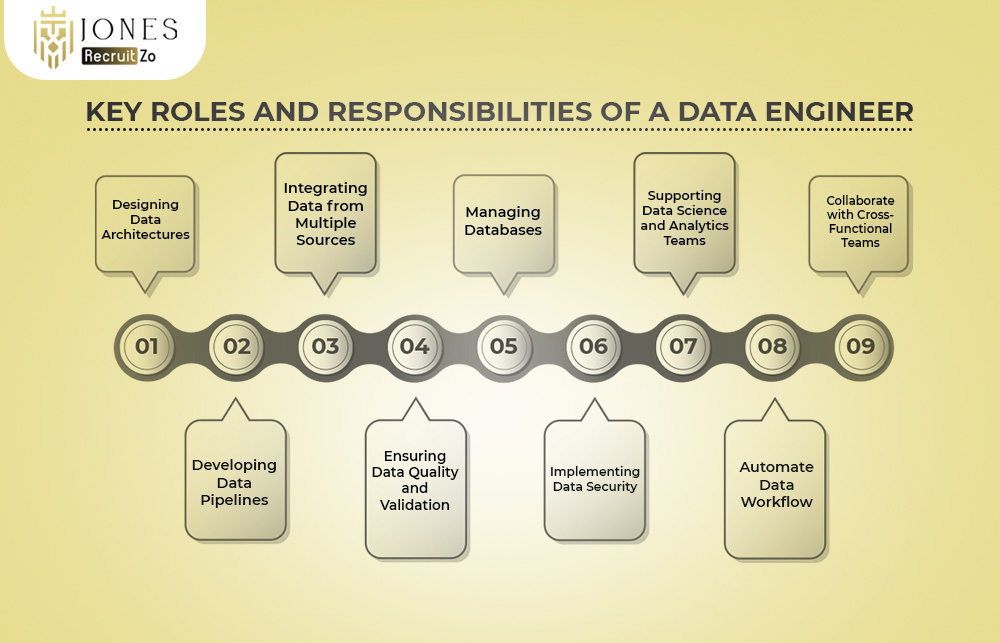
The data engineer is one of the most important specialists when it comes to developing and keeping up the data-driven decision-making systems within a company. They are responsible for creating the entire data infrastructure, such as the ones that store, process, and deliver data to different business departments. Besides, the data engineer’s job is to make sure that the data coming from various sources reaches the end-user quickly and in a manner that is accurate, trustworthy, and secure.
Designing Data Architectures
The data engineer has among his/her most important tasks to design sturdy data architectures. This means that the professional has to come up with the basis that sets up how the data in the whole company will be gathered, stored, and accessed. A data architecture that has been well-designed will facilitate all data operations to be scalable, integrated smoothly, and performed at high speed. Besides, it will be up to the data engineers to make sure that the architecture design is based on the company’s goals and technology infrastructure.
Developing Data Pipelines
Data engineers create data pipelines that automatically bring information right from the sources to the storage systems and analytics platforms. The process of when the data is being extracted, transformed and loaded (ETL) is done fast and smoothly, thus giving the analytics teams real-time access. Well-structured pipelines also help to get rid of manual mistakes, speed up the process and make sure that the right amount of data is always available. The data engineers will keep an eye on the pipelines and also optimise them continuously in order to keep them reliable and performing well.
Integrating Data from Multiple Sources
Companies do depend on a multitude of systems, which include CRMs, ERPs, and web applications. The data engineer’s task is to bring together the data from these systems into one central repository or data warehouse. The integration will make it possible that the data is consistent, and at the same time, it is very easy to access for analysis purposes. They also manage data mapping and transformation to maintain uniformity across platforms.
Ensuring Data Quality and Validation
To maintain data accuracy, which is the backbone of correct business decision-making, data engineers are to use validation checks and cleansing procedures in their data. Data engineers prepare automated scripts that spot inconsistencies and/or missing values and also take measures to solve them. The quality standards across systems are kept with the help of their regular data audits, which are also part of their job.
Managing Databases
Database management is a major task for every data engineer. They take care of the design of the database schemas, storage management, and performance optimisation for large datasets. Depending on the needs of the organisation, data engineers may work with the relational (e.g., MySQL and PostgreSQL) or non-relational (e.g., MongoDB and Cassandra) databases. Proper database management makes sure data can be retrieved smoothly and that scalability is feasible in the long run.
Implementing Data Security
Due to the steadily rising amount of sensitive data processed, data security is now among the most important concerns. Data engineers take the lead in formulating security policies and making them available to the different users of the data, which will be protected from unauthorised access or leaks. This involves the application of encryption, user authentication, and compliance with regulations like GDPR. They also join forces with the IT security departments to carry out audits that will help maintain the security of the infrastructure and the confidentiality of the data.
Supporting Data Science and Analytics Teams
Data engineers act as the backbone of analytics and data science operations. They provide clean, structured, and accessible data that enables analysts and scientists to generate insights. By collaborating with these teams, data engineers ensure the data infrastructure supports advanced analytics, machine learning, and reporting needs. Their support allows faster experimentation and data-driven decision-making.
Automate Data Workflows
Automatic data handling is the main thing that data engineers do. Automation makes it possible for data engineers to cut down on the manual work and thus improve the overall operational efficiency. Identification and design of the automated processes for data ingestion, transformation and reporting are done by the data engineers. They use various tools like Airflow or Prefect for this purpose. With automation, errors are reduced to the least, and fast data availability is guaranteed. Besides that, there is also guaranteed continuous workflow even when there is a peak in operations. This is a very supportive approach that allows the engineers to concentrate on the strategic improvements.
Collaborate with Cross-Functional Teams
The data engineers have a very close relationship with the software developers, business analysts, and project managers. This relationship helps to align data initiatives with the organisational objectives. Support from each side ensures that the technical systems will be built according to business needs and will eventually contribute to the long-term growth of the company. The cooperation allows the data engineers to carry out the function of a translator between the mountain of data and the pixel of knowledge that can be used in decision-making in every department.
Top Skills Required to Become a Data Engineer

A data engineer needs a mix of technical expertise, analytical skills, and problem-solving abilities to manage complex data environments effectively.
Programming
To take the role of a data engineer, one should be very familiar with the programming languages. Strong programming skills are required throughout the entire workflow, e.g., for writing scripts, building ETL, and managing databases. Python, Java, and Scala, among others, are the main languages for automating data operations. Programming also allows them to know how to work with big data frameworks and develop custom solutions for the data business that are exactly what the company needs.
ETL Tools
ETL (Extract, Transform, Load) tools are the building blocks of a data engineer’s daily duties. These tools make it possible to move data efficiently through the systems while quality and consistency are kept. Knowledge of the platforms like Apache Airflow, Talend, or Informatica is a must for facilitating workflow automation and data integration.
Big Data
As human capital and virtually every other resource a company has become competitive, big data technology know-how has become the ultimate requirement. Hadoop, Spark, and Kafka are the main tools that data engineers are using for the processing and examining of the vastest datasets. Distributed systems knowledge is a plus since they could then make the scalability and real-time processing of batch data solutions for both ends of the spectrum possible.
Cloud Computing
It is not an exaggeration to say that modern-day data engineering is mainly dependent on cloud infrastructure. Learning the ins and outs of AWS, Google Cloud, or Azure platforms/non-platforms enables engineers to set up and run large-scale data systems. Cloud computing is responsible for the affordability aspect, flexibility, and also the fact that the data services are always available to be utilised by the worldwide operations.
SQL & Python
SQL and Python are the most basic skills of the data engineer who is supposed to query databases and write scripts for automating data. SQL helps to view and change structured data, while Python provides further data processing features. These two tools enable engineers to manage various datasets very well and also to automate the processes that are done again and again.
Challenges Faced by Data Engineers
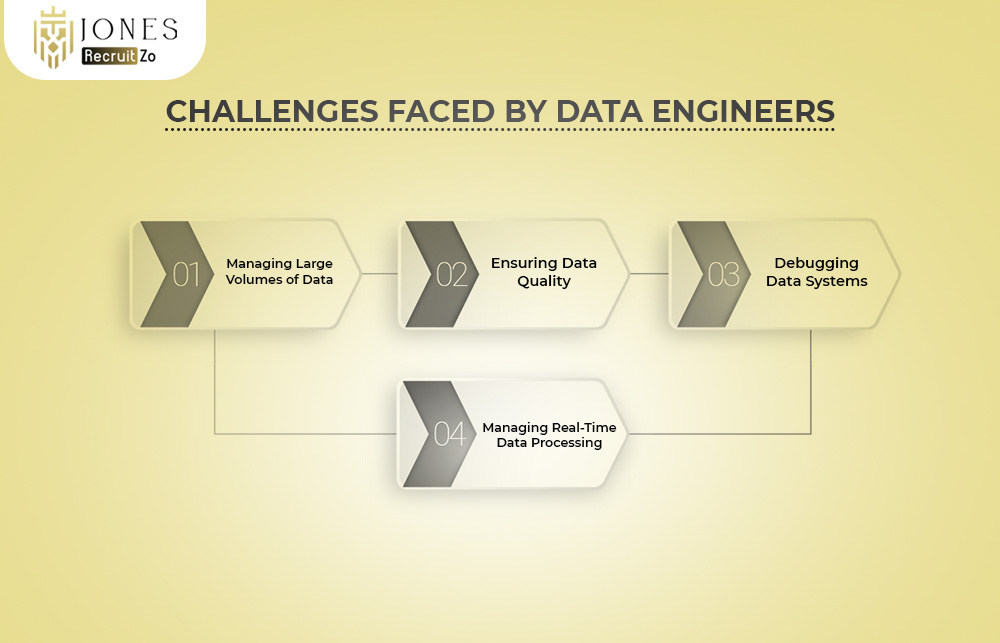
While the role of a data engineer is rewarding, it also comes with several operational and technical challenges that demand strategic solutions.
Managing Large Volumes of Data
The handling of gigantic datasets from various sources can be difficult and demanding in terms of resources. Data engineers are the ones who make sure that the systems are upgradable so that the information that is being stored and processed can grow without any problem and the efficiency remains high. They depend on the distributed storage and processing systems to keep the performance at the maximum level even during large-scale operations.
Ensuring Data Quality
The inconsistencies or inaccuracies in data can lead to the disruption of the analytics and the decision-making processes. The engineers are obliged to put in place the automatic validation, cleansing, and monitoring systems to be able to uphold the high data standards. Frequent checks and error alerts are the means by which all business applications are kept supplied with reliable data throughout.
Debugging Data Systems
The process of identifying and fixing the problems that have occurred in the data pipelines and architectures is a very time-consuming one. Debugging is a very intensive process as it requires a thorough understanding of code, data flow, and system dependencies, among other things. Data engineers have to depend on diagnostic tools and logging mechanisms in order to locate errors and bring the disruptive aspect of the functionalities to an end quickly.
Managing Real-Time Data Processing
Organisations are very much dependent on real-time insights for prompt decisions in the digital environment of today. The management of live data streams calls for powerful processing, sophisticated infrastructure, and constant optimisation. It is up to the Data Engineers to find the right balance between speed, accuracy, and reliability when creating the real-time systems.
FAQ
1) What are the main roles and responsibilities of a data engineer?
A data engineer usually takes care of data infrastructure design, construction, and maintenance. Their work includes the creation of data pipelines, the administration of databases, the protection of data, and the provision of support to the analytics staff.
2) What are the key skills needed to be a data engineer?
The most important skills are programming (Python, Java, SQL), proficiency in ETL tools, handling large-scale data, and knowledge of cloud computing. Also, strong problem-solving and teamwork skills are very important.
3) What are the key programming languages used by a data engineer?
Among the programming languages employed by a data engineer, Python, SQL, Scala, and Java are the most widely used for data engineering tasks, including automation and data processing.
4) What are the most commonly used tools by data engineers?
Some of the most popular tools are Apache Airflow, Hadoop, Spark, Talend, and AWS Data Services. All these tools help manage data pipelines, storage, and analytics operations effectively.