Key Insights
Third-Party Payroll Meaning
Third-party payroll means handing over payroll processing to a provider that takes care of all aspects, namely salary processing, compliance, and maintaining employee pay records. With this solution, companies can easily turn over the operating part to specialists for the best possible payroll management.
Benefits of Using Third-Party Payroll
It brings time savings, less HR work, better compliance, accuracy, and data security as the main benefits. These pluses allow companies to work more smoothly and to keep the administrative time down.
How Does Third-Party Payroll Works?
The method consists of organised steps like data gathering, attendance monitoring, wage calculation, payroll payment, and compliance filing. Each step maintains transparency and careful dealing with payroll.
What Is Third-Party Payroll?
Third-party payroll is a solution through which a company takes the help of an external agency that specialises in payroll processing and related functions for salary compliance and statutory filing to deal with its payroll activities. By not taking care of payroll internally, companies trust that the trained payroll specialists will manage the whole process involving employee information, working hours, salary computations, and legal obligations. The practice of outsourcing payroll is attractive, as it provides the assurance of correctness, diminishes the burden of administration, and contributes to the overall productivity of the firms.
Key Benefits of Using Third-Party Payroll
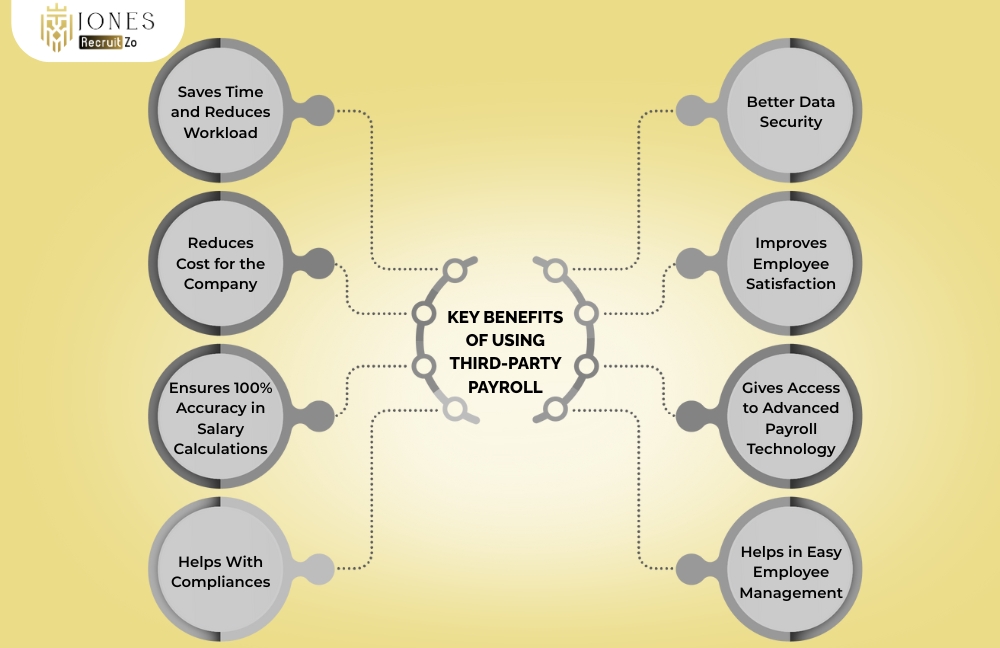
Introducing third-party payroll unlocks several advantages that support business efficiency and employee satisfaction.
Saves Time and Reduces Workload
By outsourcing payroll, human resources departments no longer have to deal with manual processing, paperwork, and monthly reconciliation. Instead, the HR staff will be able to devote their time to the strategic areas of the organisation, like hiring, employee engagement, and performance management, which are normally stagnant due to routine administrative work. With the removal of repetitive administrative tasks, HR teams come to have more productive time distributed over core organisational functions. It also lessens the internal staff fatigue who would otherwise be doing the job of managing and processing large volumes of payroll data.
Reduces Cost for the Company
There are many expenses, like payroll software, staff training, and compliance, that come with having an in-house payroll department. A third-party payroll service provider takes care of these costs, saving the company and at the same time providing professional expertise to the company. Businesses also do not have to pay for system upgrades, specialised payroll licences, and recurring maintenance fees. Because providers work at scale, companies benefit from reduced per-employee processing costs. In the long run, it will be financially worth it for the business in the times of upcoming organisations, especially for the ones that are getting bigger.
Ensures 100% Accuracy in Salary Calculations
The use of automated systems along with skilled payroll specialists guarantees that third-party providers perform salary calculations without mistakes. This leads to a reduction in disputes, an increase in the trust of employees, and the consequent ensuring of correct payouts every month. Automated validation checks further do away with miscalculations that have to do with deductions, attendance, overtime, and reimbursements. The payroll accuracy gained through this approach improves the reliability of payroll and reduces the time HR spends dealing with queries related to salaries. Companies become more transparent to their employees in paying them accurately and therefore controlling payroll better.
Helps With Compliances
Complying with statutory regulations like PF, ESIC, TDS, gratuity, bonus and labour rules is indispensable. With the help of third-party payroll services, companies are never fully compliant and thus always faced with the risk of penalties or legal suits. The suppliers watch the regulations closely and keep the companies always acting within the laws. They also take care of producing the necessary reports and making the filings in time so that non-compliance risks are greatly reduced. This proactive policy helps the companies to keep the regulatory record clean without the cumbersome task of tracing the frequent changes.
Helps in Easy Employee Management
Through onboarding details, attendance, leaves, designations, and salary structures, third-party payroll providers manage data centrally. Employee record keeping becomes simple, and the HR department is more productive due to this. A centralised system also eliminates the duplication of data entry and greatly reduces human errors. HR teams can readily access employee information and give quicker answers to employee questions. This smoothened-up method not only enhances the overall workforce management but also enriches the internal processes.
Gives Access to Advanced Payroll Technology
Businesses outsourcing their payroll will benefit from the same modern payroll technology, as they won’t have to invest big money anyway. Third-party payroll providers utilise high-tech software, tax automation systems, and secure portals; thus, the companies involved will get access to top-notch technology for a very small amount of money. Moreover, the tools will provide real-time insights, automatic reports, and rapid data retrieval, which all will contribute to the efficiency of the organisation. The workers will also enjoy personal online areas where they can either print their payslips or check their tax data. This contemporary digital path makes it easier for the companies to conform to the changing HR tech requirements.
Improves Employee Satisfaction
On-time salary payment, accurate payslips, and prompt reimbursement all contribute to high employee morale. The more payroll problems there are, the more employee trust in the organisation grows. Reliable payroll processing makes workers feel appreciated and lowers the number of complaints in the workplace. Open and clear procedures have effect on the deductions, taxes, and reimbursements as well. The payback is that the entire organisational culture becomes more positive and stable.
Better Data Security
The third-party payroll firms are using encrypted systems and controlled access to facilities in order to protect the sensitive data, which is alongside the confidentiality of such data being reduced. They apply severe confidentiality protocols, whereby only the authorised personnel can get access to the confidential information. Besides, advanced audit trails also contribute to the accountability and security of each stage of payroll processing. This is a factor that enhances the data protection, and thus companies are able to be more confident about the critical employee information being safeguarded.
Difference Between Company Payroll and Third-Party Payroll
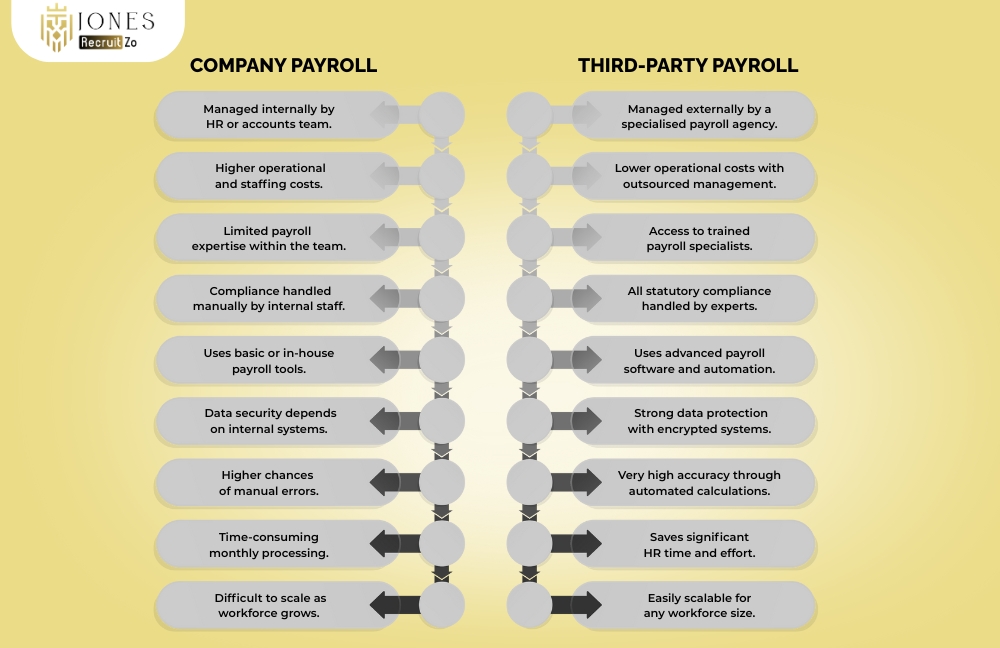
The main difference between company payroll and third-party payroll is that in-house payroll management takes place via the HR or accounts department, whereas the responsibility of payroll is moved to an outside agency in the case of third-party payroll. Payroll processing is done in-house, which means the company has to rely only on its own resources and systems and not external ones, while a payroll agency offers specialised skills, advanced software, and compliance knowledge. In this way, it is easier for companies to make the right decision considering factors like the number of employees, their finances, and main business operations by understanding the distinction between the two.
How Third-Party Payroll Works?
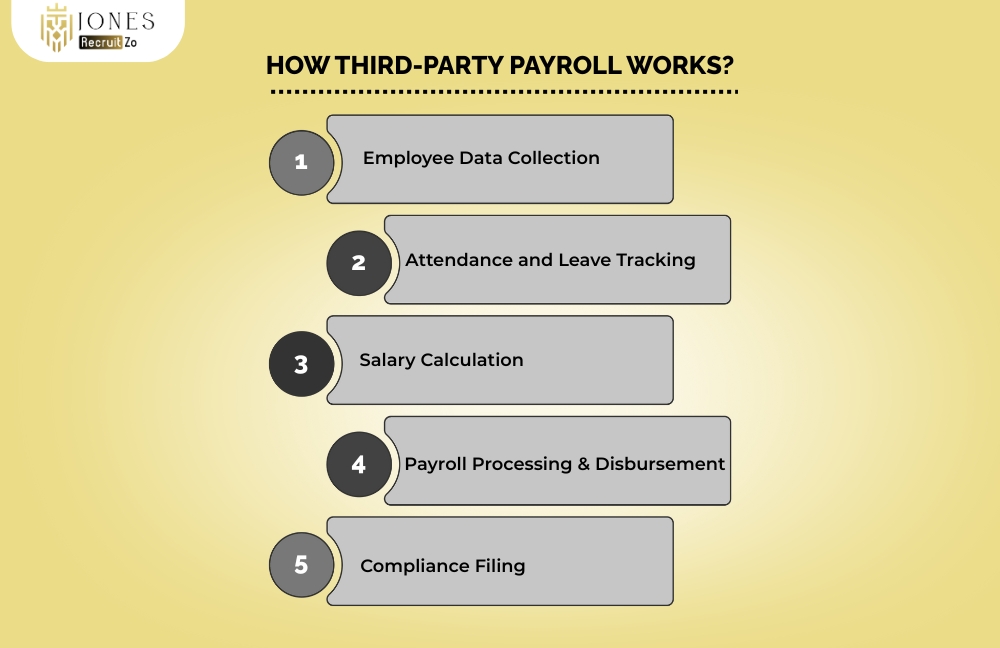
Third-party payroll follows a structured workflow to ensure accuracy and compliance throughout the payroll cycle.
Employee Data Collection
The whole procedure starts by gathering the necessary employee data, such as personal information, bank account information, job position, salary scheme, and government legal preferences. This information is the foundation upon which accurate payroll processing rests. Other documents like appointment letters, identity proofs, and tax declarations are also confirmed as valid during this phase. The payroll provider takes care of making all the employee records uniform and up-to-date before commencing the processing. Good data collection helps to limit the incorrectness in the payroll cycle later on.
Attendance and Leave Tracking
Through either biometric systems or HRMS tools, records of presence, working hours, overtime, and leave are collected. This data is utilised to determine the number of days to be paid, deductions, and overtime payments. The linking of attendance data with the payroll software prevents manual errors and guarantees that each entry is recorded without delay. Additionally, it allows for the precise supervision of late marks, half-days, and shift timings. This methodical practice creates transparency in the distribution of monthly salaries.
Salary Calculation
Considering the company’s salary policies, the calculation of the basic pay, HRA, allowances, incentives, deductions, PF, ESIC, and TDS takes place. The use of automated systems guarantees precision and wipes out human errors. The payroll service provider imposes the company-specific regulations along with the legal rules to arrive at the precise salary amounts. All the components—wages and deductions—are checked and validated through automated controls. This practice promotes uniformity among employee classifications and lowers the chances of calculation disputes.
Payroll Processing & Disbursement
Once confirmation is received, payroll processing starts and salary payments are made ready. Payslips are automatically printed and given to workers in secured ways. The payroll company works with the firm’s finance department or banking partners to make sure that salary transfers happen on time. All monetary movements are documented for audit purposes, thereby ensuring complete transparency. This process prevents payment delays for workers that could otherwise lead to distrust and dissatisfaction among them.
Compliance Filing
The payroll service handles the filing of monthly and annual statutory documents such as provident fund returns, Employees’ State Insurance Corporation (ESIC) contributions, professional tax, and tax deducted at source (TDS) etc. thereby taking all the employees’ compliance-related worries off the company’s shoulders. The service provider keeps track of the government deadlines and regulatory changes so that the filings are always current. Moreover, they keep electronic copies of all submissions for future audit and verification purposes. This total compliance management helps organisations avoid fines and stay on the right side of the law.
FAQ
1) What Is third-party payroll?
Third-party payroll refers to the outsourcing of payroll processing to an outside service provider who takes care of a company’s payroll processing, such as figuring out the salaries, filing for compliance, and maintaining payroll, for a company. With the help of highly specialized tools and automation, these providers make it possible to have payouts that are correct and on time. It reduces the operational burden of companies and at the same time maintains error-free payroll cycles.
2) What are the key benefits of using third-party payroll?
The main advantages consist of time-saving, money-saving, payroll accuracy, compliance, security, and access to the latest payroll technology among others. It also helps HR to be more productive as it removes tedious admin tasks. Moreover, companies get expert help in keeping up-to-date with the ever-changing statutory regulations.
3) What is the difference between company payroll and third-party payroll?
Company payroll is handled by company’s HR or accounts teams, while third-party payroll is done by outsourcing the payroll function to outside specialist payroll agencies which have the required technological tools and expertise. Internal payroll requires hiring dedicated staff and setting up management infrastructure, while outsourced payroll just lightens the load on the internal team. Hence, the third-party payroll comes out to be more efficient for companies that want to streamline their operations.
4) How does third-party payroll work?
It goes through a series of well-structured steps which include gathering of employee’s data, checking their attendance, calculation of salary, payroll processing, disbursement, and finally filing compliance documents. Automated systems are used in every stage to bring down errors and to provide accuracy. Continuous monitoring and reporting also contribute to maintaining transparency throughout the payroll cycle.