Key Insights
Remote Team Meaning
The term “remote team” describes a group of employees who are engaged at different places rather than a traditional office but are still using digital tools to connect with each other. This practice allows businesses to create flexible, diverse, and big teams without any limitations of location.
Best Practices for Managing Remote Teams
Great communication, proper planning, and the right digital tools are necessary to manage remote teams successfully. Using the best practices that are already established in the market can help keep the productivity level high and make sure that the teams are in line with the organisation’s objectives.
Benefits of Remote Teams
Remote teams make it possible for companies to enjoy the benefits of a better work-life balance for employees, a wider talent pool, and lower operational expenses. All these advantages, in turn, lead to better performance, employee satisfaction, and healthy business operations in the long run.
Challenges of Managing Remote Teams
On the other hand, remote work comes with some usual problems like communication barriers, weaker team relationships, and difficulties in monitoring productivity. The knowledge of these obstacles will empower organisations to create more effective remote team management strategies.
What Is a Remote Team?
A remote team refers to a collective of employees whose final destinations are outside the usual office space. The employees can telework from home, coworking spaces, or even from various cities or countries, depending on the work model of the organisation. Technology and digital communication tools, along with a systematic process, are the mainstay for making remote work productivity and collaboration.
Companies prefer remote teams for building a flexible workforce, improving employees’ morale, and tapping into the global talent pool without facing the geographical barriers.
Benefits of Remote Teams
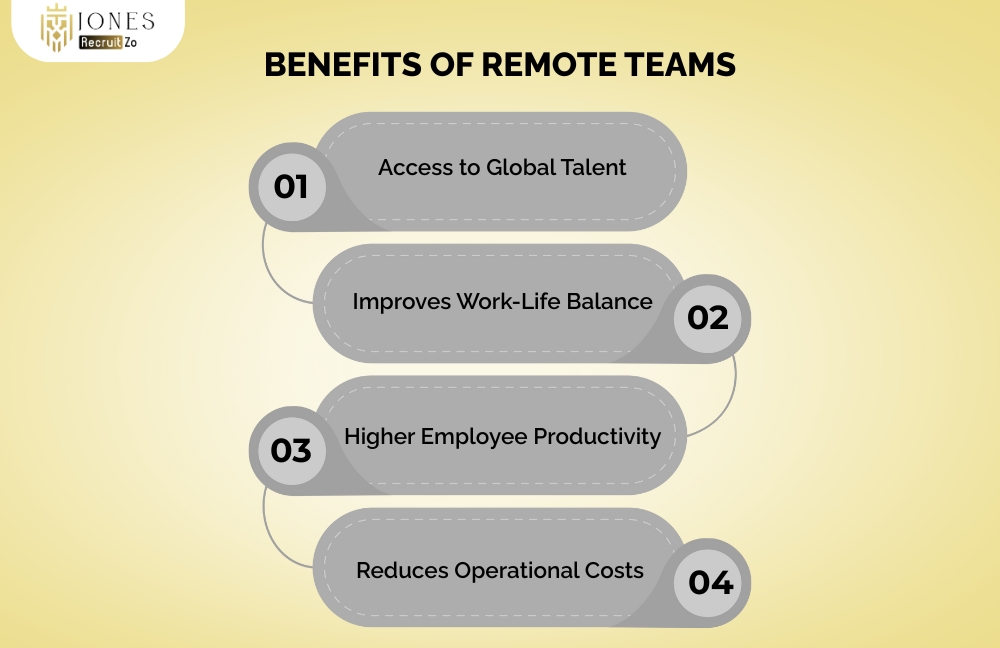
Remote teams offer several advantages that improve talent acquisition, employee satisfaction, and cost efficiency. Here are the benefits companies can expect when embracing remote work models.
Access to Global Talent
Remote hiring provides employers with the opportunity to find top talents from wherever they might be in the world. The companies are free to pick the best talent according to the skills required, irrespective of their locations. This also results in creating heterogeneous teams that are a source of the company’s creativity, innovation, and solution finding.
Improves Work-Life Balance
Remote work enables the employees to plan their personal and professional lives with a lot of flexibility. The elimination of commuting and the availability of a relaxed schedule result in the sharing of the burden and an increase of the overall mental wellness. A good balance between work and life usually means more output and satisfaction from the job.
Higher Employee Productivity
Remote workers are usually those who have created custom and comfortable environments around them that enable them to concentrate. The absence of many distractions, as well as more control and responsibility over their work processes, tends to lead to faster completion and higher quality of the work. A lot of research has demonstrated that while working under the right management, the performance of remote teams is always higher than that of teams working in the traditional office.
Reduces Operational Costs
Businesses save significantly on office rentals, electricity, maintenance, and other overhead expenses when teams work remotely. These savings can be invested in digital tools, employee benefits, or strategic growth initiatives. Reduced operational expenditure improves overall business efficiency and financial performance.
7 Best Practices for Managing Remote Teams
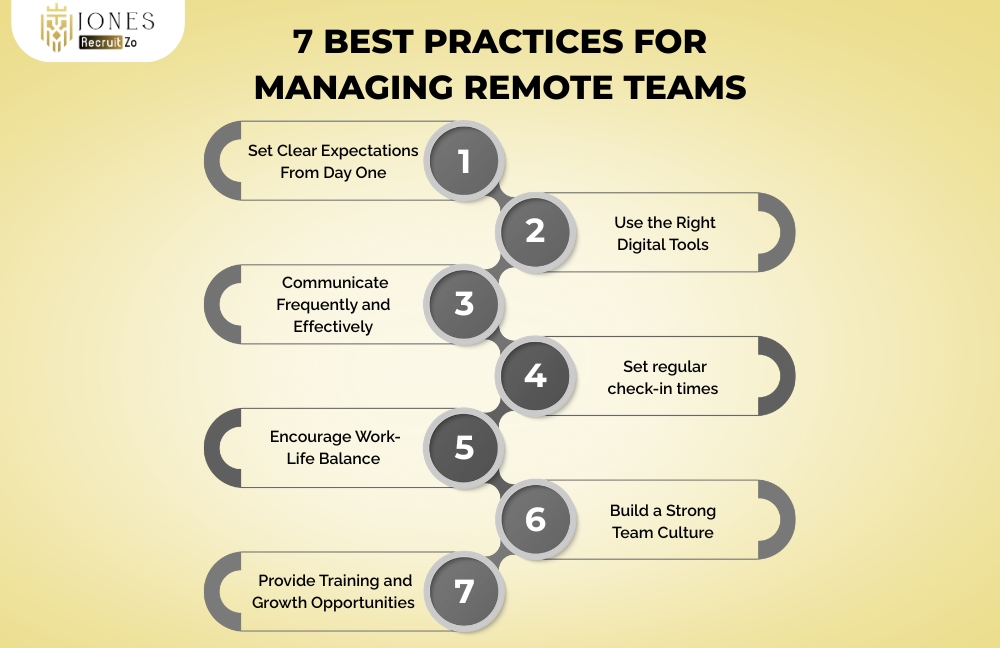
Managing employees who work from different locations requires structured planning and strong leadership. Here are the best practices that help organisations improve communication, performance, and teamwork in remote work settings.
Set Clear Expectations From Day One
By setting the expectations right at the beginning, the employees will get to know what is expected of them in terms of deliverables, hours of work, ways of communication, and performance targets. Very clear onboarding directions help remote employees to be sure about their tasks. When the expectations are set from the very start, the teams are more synchronised and do not have to go through the trouble of confusion and delays that are unnecessary.
Use the Right Digital Tools
Digital cooperation tools are needed by remote teams to work closely and efficiently. Various kinds of platforms, such as project management software, chat apps, and cloud storage systems, enable employees to collaborate without any disturbance. It is thanks to those tools that information is kept together, the process is systematic, and communication throughout the entire organisation is clear.
Communicate Frequently and Effectively
Communication that is kept regular allows employees who are working in different locations to feel connected and up to date. The management should keep the communication lines open to talk about the tasks, clarify the doubts, and provide the employees with guidance whenever required. On the one hand, effective communication leads to the development of relationships that are closer; on the other hand, it decreases misunderstandings and keeps the remote teams in line with the organisational objectives.
Set regular check-in times
Check-in meetings give the employees a chance to report on their work, talk about their progress, and voice their concerns. The meetings help the managers to keep track of the activities and to offer support promptly when needed. Frequent check-ins also improve the relationship between the employees, trust, and accountability, thus making it more effective and less tedious for the teams to work together in different locations.
Encourage Work-Life Balance
Sometimes the remote workers find it hard to separate themselves from work because the division between home and office has become vague. Therefore, the employees are being supported by regular breaks, flexible working hours, and the establishment of healthy routines that help them to maintain balance. The supported teams display better morale, less burnout, and ongoing productivity.
Build a Strong Team Culture
It is essential for the remote teams that are rarely in person to feel belongingness. Virtual team bonding activities, communication and open practices, as well as cultural celebrations, are some of the ways in which relationships can be further formed. A good company culture not only makes the workers feel appreciated but also provides them with motivation and a link to the company’s objectives.
Provide Training and Growth Opportunities
Learning and development are very crucial for a remote professional to keep his/her/their engagement as well as advance his/her/their skills. Online training programmes, mentorship sessions, and career development initiatives are some of the ways in which the employee can grow. Moreover, the offering of learning opportunities that are continuous also strengthens retention and increases job satisfaction.
Challenges of Managing Remote Teams
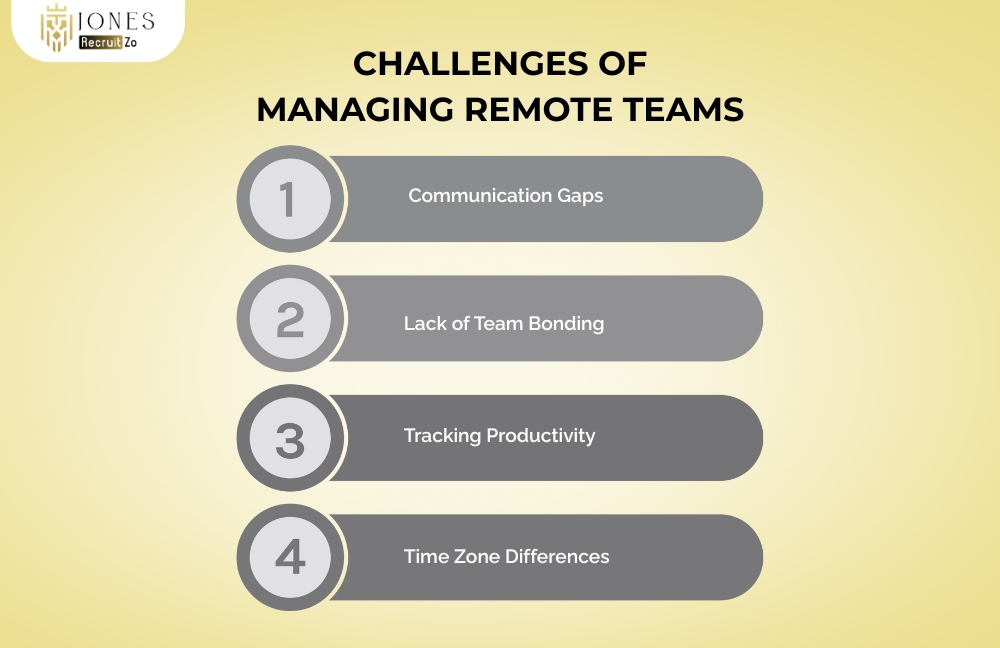
Remote work brings many advantages, but it also comes with challenges that organisations must address to maintain efficiency. Here are the main challenges companies face when managing remote teams.
Communication Gaps
There might be delays or misunderstandings in communication among remote employees without the help of in-person interactions. Most of the time, important news is not delivered to the right people at the right time. To avoid these issues, companies need to set up communication channels that are well-structured and that everybody understands.
Lack of Team Bonding
Remote workers usually operate alone most of the time, and this can lead to less team bonding. When people are not connected with their coworkers, the level of engagement may drop. It is the role of the managers to come up with virtual events and group activities that will keep the team united and collaborative.
Tracking Productivity
The process of monitoring performance becomes difficult if the workers are scattered in different places. The managers may have a hard time figuring out which tasks have been completed and which ones are still ongoing or whether the deadline has been met. Using tools such as digital dashboards and performance metrics can help keep a more accurate record of productivity.
Time Zone Differences
Having teams around the world means they would be working in different time zones most of the time, which would make it difficult to have meetings and collaborate. Delays in communication and the lack of overlapping hours may cause disruptions in the workflow. Project managers have to be very meticulous in setting deadlines, and they should encourage the use of asynchronous communication when necessary.
FAQ
1) What is a remote team?
A remote team refers to a set of employees working from different locations rather than a central office. They are communicating through digital tools and make use of the structured processes to collaborate effectively over long distances.
2) What are the benefits of remote teams?
Access to global talent, greater productivity, better work-life balance, and lower operational expenses are among the main benefits. Remotely working, in addition to these factors, also gives rise to more flexibility, which in turn results in employee satisfaction.
3) What are the challenges of managing a remote team?
Some of the most common challenges that managers face include poor communication, lack of team cohesion, difficulties in monitoring productivity, and the problem of differing time zones. Proper digital tools and strong planning are necessary to overcome these challenges.
4) How to manage a remote team?
Effective remote team management can be done by having clear expectations, using appropriate tools, constant communication, and establishing a positive work culture. Moreover, proper training and regular check-ups help to keep an employee’s performance and engagement high.