Key Insights
Performance Appraisal Meaning
Performance appraisal is a formal process where an employee’s work performance is evaluated according to a set criterion within a specified time frame. It is a way for organisations to track the output, reveal the strong points, and indicate the areas that need to be worked on. The process thus allows for justifiably making decisions with regard to promotions, salary increments, and training.
Traditional Performance Appraisal Methods
Traditional appraisal systems rely on evaluating workers according to their past performance, established criteria, and supervisors’ observations. These methods are straightforward, simple to implement, and have been in widespread use in companies that prefer non-complicated evaluation systems. They typically focus on individual performance rather than on behavioural or future-orientated criteria.
Modern Performance Appraisal Methods
Modern appraisal techniques have a broader and more complex approach to measuring employee performance. They give priority to the evaluation of behaviour, the provision of continuous feedback, and the potential for future growth rather than just the past accomplishments. Such methods not only support the strategic HR goals but also the corporate objectives in employee development.
What Is Performance Appraisal?
Performance appraisal is an organised activity that companies use to evaluate their workers’ performance, point out their good and bad sides, and connect their input with the company’s targets. It aids the human resource departments in determining the degree of compliance of employees with the standards and in making decisions regarding the training of new employees, promotions, salary increases, and the planning of the workforce. By providing feedback that is quantifiable, performance appraisals are one of the factors that bring about the continuous improvement of individuals and the organisation as a whole.
Different Types of Performance Appraisal Methods
Performance appraisal methods help organisations review employee performance systematically. They can be broadly categorised into traditional and modern methods, each offering specific benefits depending on organisational needs.
Traditional Methods of Performance Appraisal
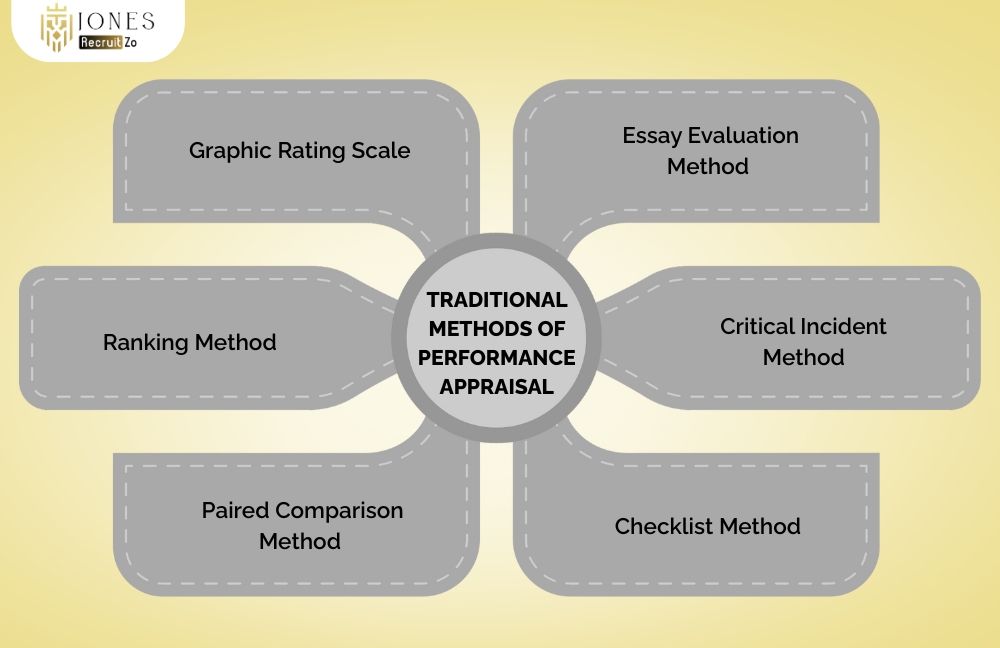
The classic performance appraisal techniques consist of the application of structured evaluation methods led by supervisors and used in a range of different organisations for several decades. The main concentration of these methods is on the previous performance, behavioural observations, and measurable criteria that were, in essence, set by managers. Therefore, they represent a straightforward and inexpensive way of dealing with employee productivity reviews, particularly in the case of organisations where job roles are stable.
Even though traditional methods sometimes may be subjective, they still offer a solid structure for rating employees based on already established norms. The majority of the companies still consider these methods as the primary basis for the later part of the modern appraisal tools’ integration.
Graphic Rating Scale
The graphic rating scale is a traditional performance appraisal method that is quite simple and commonly used. Employees are given ratings according to certain signs like punctuality, communication, job knowledge, teamwork and productivity. Each character receives scores on a predetermined scale which is generally from poor to excellent. In this way, managers are able to estimate performance quantitatively. It also helps HR personnel to quickly find out the consistency and skill levels of the employees.
Ranking Method
In the ranking method, employees are grouped within the same job category and are then compared to each other accordingly, being ranked from the highest to the lowest performing employee. Managers assess the total performance and determine who is the most efficient and who is the least efficient. The method is simple to apply but can be criticised for not giving a very detailed picture, since the employees’ performance is compared against each other rather than to the predetermined objective criteria. However, this method is good for spotting the best talent and the people who need some training.
Paired Comparison Method
The paired comparison method is a technique where two employees are evaluated at a time and compared to each other on certain job-related criteria. That means every employee will be compared with each other, and in each case the one who is better gets a point. After that, all points are summed up to rank the performances. The paired comparison method minimises subjectivity and guarantees a well-organised assessment procedure, especially when implemented with small groups.
Checklist Method
The Checklist Method has the managers answering a set of yes/no questions about the performance, conduct, and characteristics of the employee. Each ‘yes’ or ‘no’ response in the list is allotted a score, and the cumulative score denotes the performance level overall. This method tends to be less dependent on personal opinion, as the managers only prove if the employee acts as described in the behaviours provided. It also enables HR to have consistent evaluations across different departments.
Critical Incident Method
In the Critical Incident Method, the focus is on recording very important positive or negative events that are related to an employee’s behaviour. Managers keep a record of such incidents during the appraisal period, and by these they assess performance. The method is very informative, as it shows particular cases that affect either the output or the work culture. It also points out the behaviour that, if corrected or recognised, may improve the productivity.
Essay Evaluation Method
The essay evaluation method requires the managers to write a detailed narrative about the employee’s performance. It takes into account the employee’s strengths and weaknesses, achievements, and areas where improvement is required. This way, the manager is able to give qualitative insights that cannot be quantified through numerical ratings. On the other hand, it is very dependent on the evaluator’s writing skills and may vary in detail from one appraiser to another.
Modern Methods of Performance Appraisal
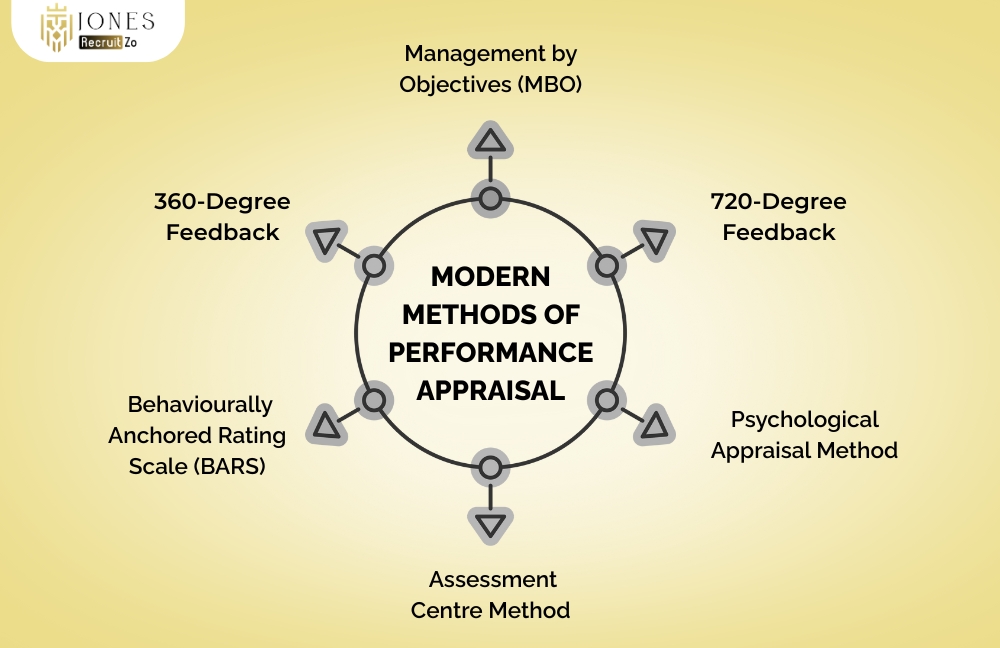
Modern appraisal methods focus on providing a holistic, forward-looking evaluation that considers behaviour, skills, and future potential. These approaches use continuous feedback and structured frameworks to support employee development and organisational growth.
Management by Objectives (MBO)
With the MBO system, precise and measurable targets for staff are set at the start of the evaluation period. The performance then is measured through how well those goals are accomplished. The use of this technique fosters responsibility and guarantees the coordination of individual aims with the corporate goals. It also supports the ongoing dialogue between the staff and the managers.
360-Degree Feedback
The 360-degree feedback technique collects performance data from several sources, such as managers, colleagues, lower-level employees, and at times, even customers. It gives a comprehensive view of a person’s strong points, ability to interact with others, and his/her skills that need improvement. This technique works great for management positions where feedback from different parties is critical.
Behaviourally Anchored Rating Scale (BARS)
BARS merges the advantages of rating scales with critical incident methods. It applies evaluations based on behaviour-related descriptions tied to numerical ratings, which results in more objective assessments. Every evaluation is connected to given examples of behaviours, which helps eliminate the problem of being vague and inconsistent. It is especially advantageous when analysing jobs that demand certain types of behaviour.
Assessment Centre Method
The assessment centre method provides employees with participation in various activities like simulations, group discussions, role-play, and case studies. Their performance is monitored by qualified assessors who see the conduct in different situations and give their feedback. The method is popular for promotions and provision of leaders since it determines if they are ready for the job and whether they possess sound decision-making skills.
Psychological Appraisal Method
Psychological assessment gives importance to the employee’s potential over what he or she is currently able to do. Trained psychometrists evaluate such a person’s mental faculties, emotional make-up, leadership characteristics, and social skills through tests and interviews. This practice is beneficial for the organisation, as it will assist them to discover the gems that are eligible for future leader’s or expert’s positions.
720-Degree Feedback
The method of 720-degree feedback adds dimensions to 360 degrees evaluation by involving subsequent assessments to check progress over the period. Staff members receive judgements from inside and outside the company in two phases—initial assessment and post-improvement assessment. The methodology fosters constant growth and responsibility.
Why Is Performance Appraisal Important?
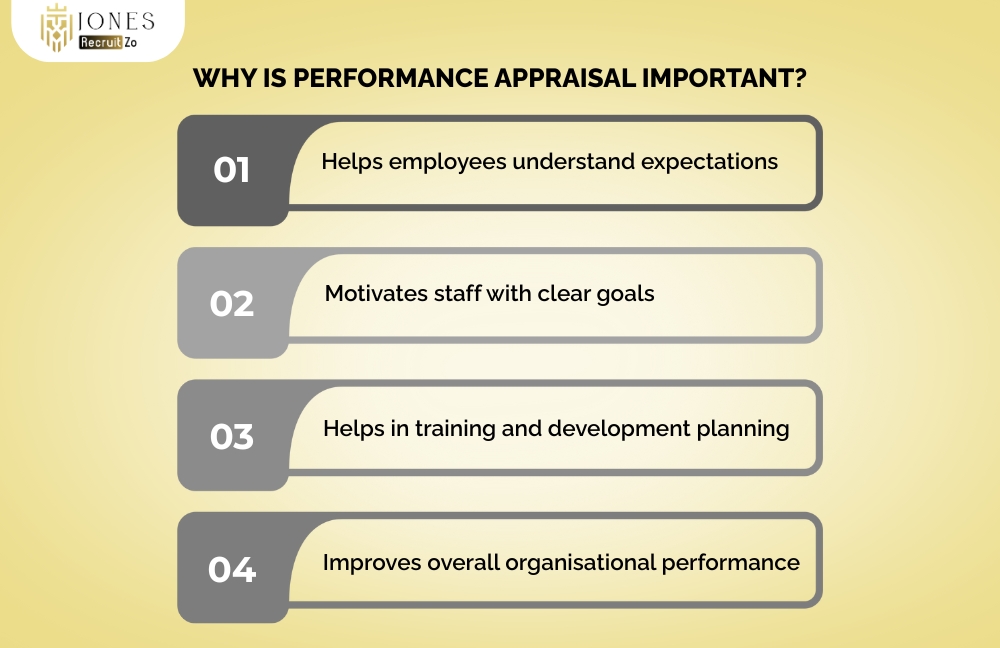
Performance appraisals play a crucial role in aligning employee efforts with organisational goals. They provide clarity on expectations, help identify strengths and areas for improvement, and serve as a foundation for training, development, and career growth. Effective appraisals also boost motivation, engagement, and overall organisational performance.
Helps employees understand expectations
Performance appraisals clearly define job expectations, enabling employees to understand what is required of them. This clarity helps them stay aligned with organisational goals and reduces confusion around responsibilities and targets.
Motivates staff with clear goals
Appraisal talks make it possible to set goals that are within reach and to reward accomplishments. The more workers realise what they are striving to attain, the more they will get motivated, be productive, and feel involved. Goals that are clear and structured also give a sense of direction, helping staff members to notice their progress. This results in increased morale and a greater dedication to the accomplishment of the company’s objectives.
Helps in training and development planning
Performance evaluations help human resources departments to prepare appropriate training programmes by pinpointing skill deficiencies. As a result, the workers are helped to perform better and also get the chance to develop their careers.
It also simplifies the process of identifying future positions and career paths, enabling companies to channel their development efforts in a specific direction. In due course, this enhances the internal talent pool.
Improves overall organisational performance
An effective appraisal system is like a productivity booster, as it ties employee performance to business outcomes. The organisation gets to enjoy the advantages of the employees’ better performance in terms of efficiency and the quality of work produced being higher. Regular performance reviews mean that employees are accountable and are always working towards improvement. This is how the company creates an environment where good performance is the norm.
How to Choose the Right Performance Appraisal Method?
The choice of the right method is determined by the objectives of the organisation, the specific job positions, and the amount of detail that is necessary. Organisations must take into account things like the size of the team, the complexity of the job, the level of precision needed, and the amount of time to be spent. Conventional methods are appropriate for simple positions, whereas modern methods are ideal for the fast-paced settings where ongoing training and multi-source feedback are important. Choosing the appropriate appraisal method brings about fairness, precision, and practical insights.
FAQ
1) What are the different types of performance appraisal methods?
Performance appraisal methods consist of traditional methods like the graphic rating scales, ranking, paired comparison, essay evaluation, and the critical incident method, but also the modern ones such as MBO, 360-degree feedback, BARS, assessment centres, psychological appraisal, and 720-degree feedback. The selection of methods by organisations depends on the job roles, the objectives of the appraisal, and how deep the evaluation should be.
2) What Is Performance Appraisal?
Performance appraisal is a systematic assessment of an employee’s performance in the job during a set period. It contributes to the evaluation of accomplishments, the locating of areas for improvement, and the support of decisions regarding promotions, training and compensation.
3) What are the traditional methods of performance appraisal?
Traditional methods are represented by the graphic rating scale, ranking method, paired comparison method, checklist method, critical incident method, and essay evaluation method. Through simple evaluation techniques, these methods concentrate on individual traits and behaviours.
4) What are the modern methods of performance appraisal?
Modern methods embrace Management by Objectives (MBO), 360-degree feedback, Behaviourally Anchored Rating Scale (BARS),the assessment centre method, psychological appraisal, and 720-degree feedback. These techniques are characterised as being more comprehensive, data-driven, and appropriate for leadership and dynamic roles.