Difference Between Training and Development in HRM
Training and development in human resource management (HRM) are the two main factors that increase the performance of the workforce and growth of the organisation. Though both aim at the improvement of the employees’ capabilities, they still differ in purpose, focus, and their long-term impact. Employees’ technology and job-related skills are the focus of training, while development nurtures future leadership and professional advancement.
What is Training in HRM?
Training in HRM is a systematic course of action that is executed to boost the skills and knowledge of an employee to the level required for their current position. It targets the efficient operation of the organisation, accuracy, and productivity concerning the existing tasks of the employee by closing the skill gaps through training in various forms like workshops, simulations, or e-learning sessions.
What is Development in HRM?
Development is a wide-ranging, long-term undertaking that cares for the employee’s entire professional growth and future potential. The employee is provided with the necessary qualities to take up higher positions through his/her being groomed in leadership skills, strategic thinking, and being open to change. A lot of the development process consists of mentoring, career planning, and learning through various experiences that are all aimed at preparing the future workforce, which is stronger and more competent.
Key Differences Between Training and Development
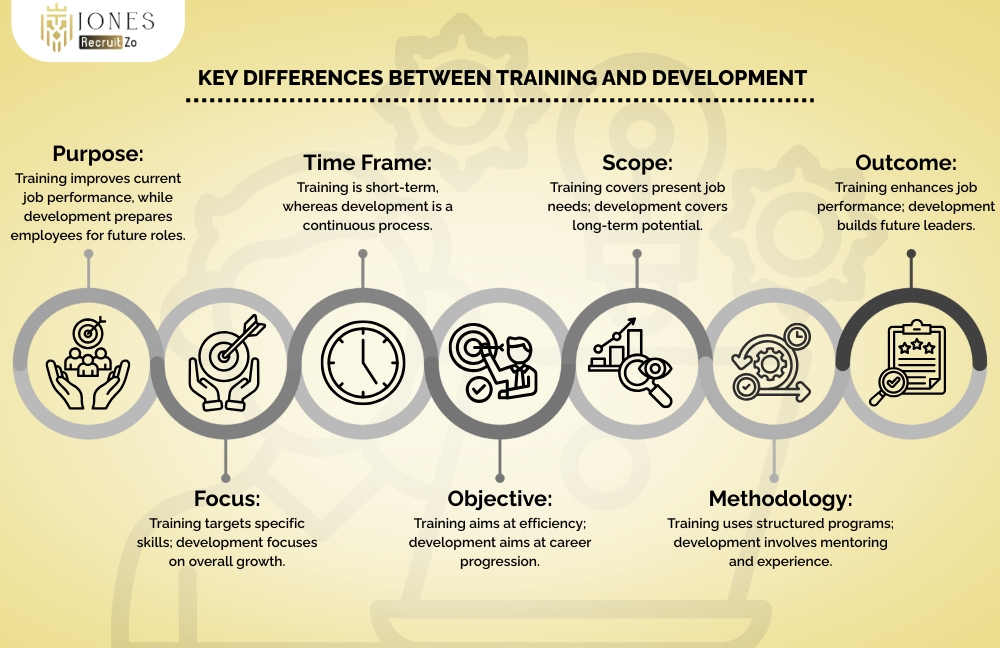
Though training and development work hand in hand, they serve different goals within HRM. Training is short-term and task-focused, while development takes a holistic approach to prepare employees for long-term success.
Purpose
The main reason for training is to provide a quick boost to job performance. Conversely, development intends to provide a solid floor for the employees’ future potential and long-term career growth in the organisation.
Focus
Training work on the upgrading of specified talents or technical know-how that is necessary at the moment. Development targets the area of character, managerial, and personal skills that are in general behind the leader and the organisation’s success.
Time Frame
Training is often delivered in a matter of days or weeks, which is a short period, to meet the urgent skill requirements. The development process, on the other hand, is long-lasting and may last for months or even years, with the main aim of career and personal growth.
Objective
The main aim of training is that the employees are able to carry out their current duties efficiently and comply with the organisation’s standards. On the contrary, the development process prepares the employees for future challenges and assignments with higher authority.
Scope
Training is of a narrow scope, dealing exclusively with certain tasks, tools, or software. A wider range of learning is allowed under development, including emotional intelligence, leadership, and strategic decision-making.
Methodology
Training generally consists of workshops, classroom lectures, and on-the-job training. Development employs methods like mentoring, coaching, job rotations, and leadership programmes that shape one’s overall career trajectory.
Outcome
An improved performance and modernised productivity in existing roles is what training has resulted in. The development process creates a more skilled, confident, and flexible workforce that is prepared to handle future positions and duties.
Importance of Training and Development in HRM
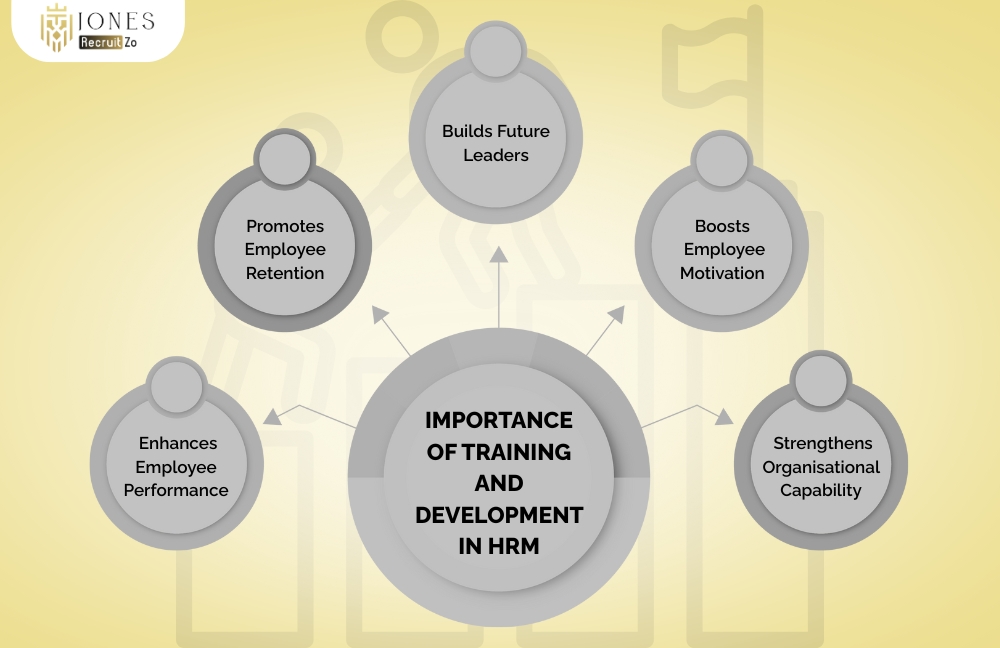
Training and development play a critical role in building a skilled, motivated, and future-ready workforce. They enhance organisational performance, promote retention, and ensure sustainable business success.
Enhances Employee Performance
Training programmes that are very effective provide workers with the necessary skills and knowledge to contribute quickly and easily. If the staff receives proper guidance regarding their functions, it translates to better quality, quicker completion of tasks, and less wastage of resources through mistakes.
Promotes Employee Retention
Employees are attracted to companies that make a point of investing in their career development. Unfolding possibilities for continuous training and development not only creates loyal workers and reduces the rates of dismissal but also results in a workforce that is stable and has a high level of engagement.
Builds Future Leaders
Through the ongoing development programmes, organisations detect and prepare the leaders of the future amongst the employees. If an organisation starts to build leadership skills in the early stages, it will be able to plan the transfer of power smoothly and to have strong managerial continuity.
Boosts Employee Motivation
Staff training and development programmes create the impression in employees that they are valuable. The employees who feel appreciated emit higher productivity, stronger cooperation, and an even deeper commitment to the organisation.
Strengthens Organisational Capability
A company that has well-trained staff can make quicker adjustments to the market, come up with new methods of production, and keep the advantage over its competitors. The training and development process keeps the employees in sync with the company’s objectives and ever prepared to face the new challenges that arise.
How HR Can Balance Training and Development
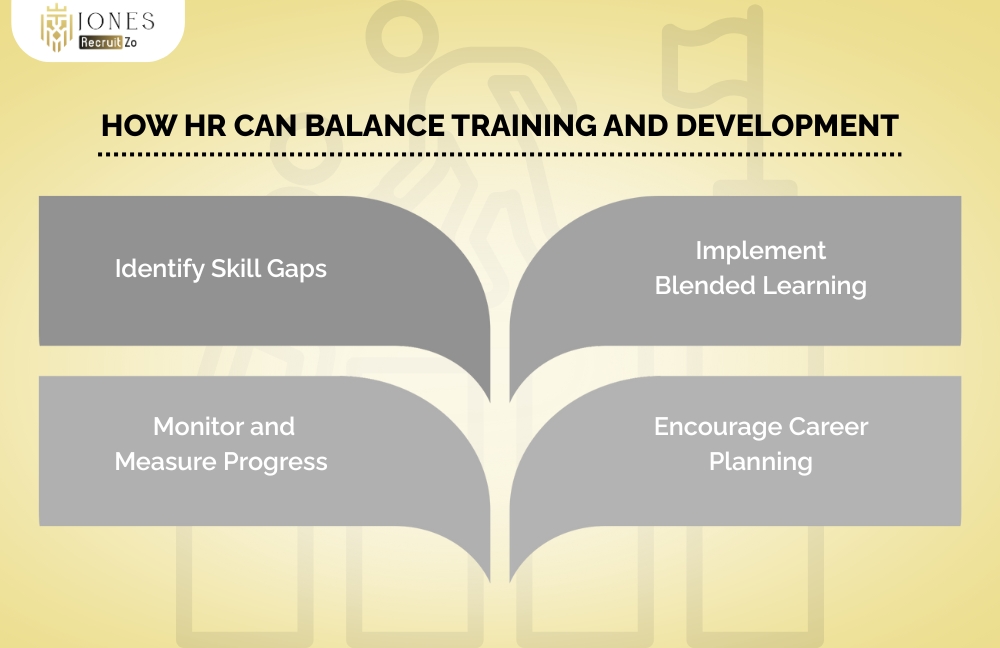
Balancing training and development ensures that employees not only meet present job requirements but also prepare for future roles.
Identify Skill Gaps
The regular appraisal of employee performance by the HR teams will help them to pinpoint the areas that require training. The conduct of skill gap analysis will make sure that learning initiatives are directed towards a certain goal and results will be based on that. The HR will then have a chance to create inmate programmes that will ultimately come out strong in closing the gaps of performance.
Implement Blended Learning
Teaching methods that mix the traditional face-to-face approach with the online method give the students the option for flexibility and access to the content. The blended learning way makes training very attractive and at the same time assures knowledge impartation throughout the organisation. It also lets the learner choose their speed without cutting off their working time.
Encourage Career Planning
Training and development should go hand in hand with personal career aspirations. Apart from that, HR can conduct mentoring programmes and workshops that will assist employees in imagining the long-term career path they have. This connection creates enthusiasm and motivates employees to develop their skills professionally and thus assume their careers.
Monitor and Measure Progress
The regular assessment of training results and development goals ensures the effectiveness of the process. The collection of feedback and the monitoring of performance will allow HR to adjust programmes in such a way as to achieve continuous improvement. The knowledge gained will in turn be used by organisations to measure ROI and hence to support their talent development strategy more strongly.
FAQ
1) What is the difference between training and development?
The main distinction between training and development is that the former hones the existing capability of the worker, while the latter, through long-term interventions, imparts to the employee the skills and knowledge required for future roles and responsibilities.
2) What is training in HRM?
Training in HRM is a systematic process that consists of various programmes aiming at the improvement of the employee’s technical and operational abilities with regard to his/her current position.
3) What is development in HRM?
Development is a process that includes various activities, such as leadership programmes, mentoring, and career planning, aimed at increasing the employees’ potential in the future.
4) Why are training and development important in HRM?
They contribute to the improvement of employees’ performance, the decline of turnover, and the formation of an organisation that is not only competitive but also capable of overcoming future business challenges.