Key Insights
Average Game Designer Salary in India
Game designer salaries in India are based on different parameters such as experience, city, and company type, with entry-level salaries of ₹3-5 LPA and senior/lead positions earning up to ₹12-20 LPA.
Factors Affecting Game Designer Salary
Affecting factors include experience, company type, technical skills, job role, tools proficiency, and location that influence earnings across the industry.
How to Increase Game Designer Salary
Salary increments for professionals can be achieved through learning skills in high-demand tools, building an portfolio, gaining specialised expertise, certification, and effective negotiation.
What is the Average Salary of a Game Designer in India?
In India, the average game designer salary varies anywhere between ₹3 LPA and ₹12 LPA based on a number of factors like education, portfolio, company type, and technical skills. Beginners are paid the least, while experienced designers working in top studios get very high salaries because of their artistic and technical abilities.
The fast-growing Indian gaming market can be attributed to investments, the spread of smartphones, and an increasing attraction to online digital experiences. Each year, the number of game development companies grows, and so does the competition for salaries. Specialists in gameplay design, UX design, or storytelling are usually the ones to receive above-average salaries.
Game Designer Salary by Experience

Salary differences based on experience help candidates understand how their earnings could grow as they gain expertise. Below is a detailed breakdown:
Entry-Level Game Designer (0–2 Years Experience)
Entry-level designers receive a salary of approximately ₹3 LPA to ₹5 LPA. The amount depends on the quality of designers’ portfolios, internships, and software knowledge. Designers of this career stage will work on simple features, basic gameplay elements, and support senior teams. Additionally, they are given the chance to learn important tools such as Unity and Blender.
Newcomers with exceptional personal game projects or design portfolios often have the upper hand in getting higher starting salaries. Besides, companies tend to value candidates who can express originality, have a problem-solving mindset, and can work with others easily.
Mid-Level Game Designer (2–5 Years Experience)
Mid-level designers take home ₹6 LPA to ₹9 LPA, which is a reflection of their growing responsibility and when they get to the peak of their skills. They are tasked with the design of intricate gameplay mechanics, player progression systems, and key interactive features that influence the user experience spot on.
Designers at this point take control of game modules and thereby work closely with developers, artists, and product managers. Their capacity to design immersive and engaging game experiences is increasing, which means such designers will soon be the most sought after by companies.
Senior Game Designer (5–10 Years Experience)
Senior designers draw a salary ranging from ₹10 LPA to ₹18 LPA plus extra depending on the company’s size and the complexity of the projects. They direct the artistic direction of the main features, train junior designers, and, in a way, make sure that the game is in line with the users’ expectations and the business’s goals.
Balancing, pacing, narrative structure, and core mechanics are some of the processes that senior designers get involved in. Partly through their strategic thinking, the company gets directly impacted by the unit product’s success.
Lead Game Designer (5–10 Years)
Lead game designers command salaries between ₹15 LPA and ₹30 LPA. They oversee entire game design teams, define the creative vision, and ensure smooth execution from concept to launch. They collaborate with department heads, evaluate user feedback, and ensure the final product is engaging, scalable, and commercially viable. Leads play an important role in shaping the company’s creative direction.
Game Designer Salary by City Wise
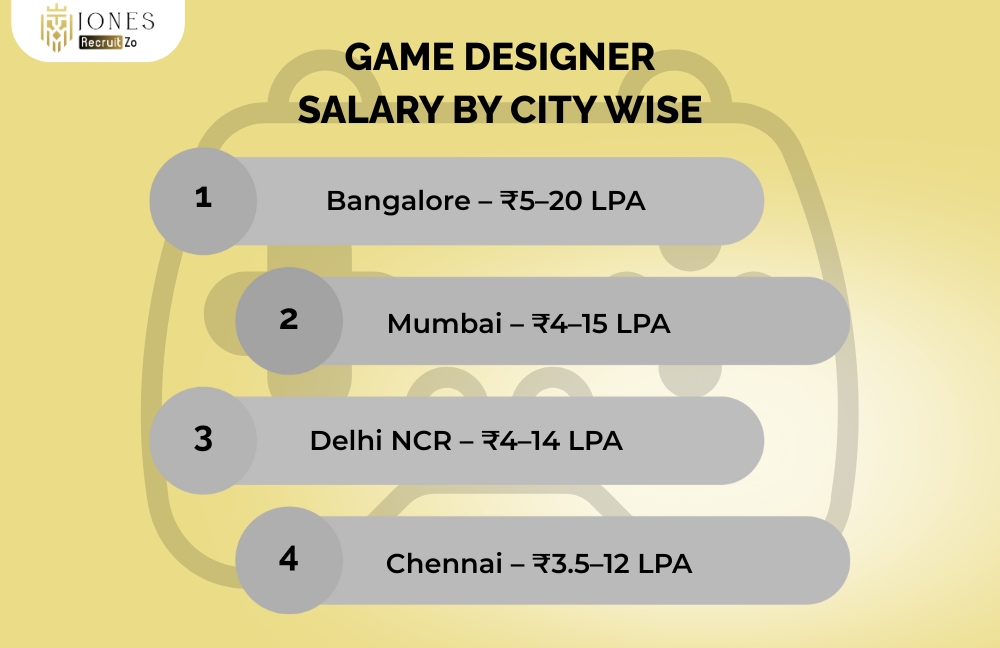
Salaries for game designers vary widely depending on the city, availability of gaming studios, cost of living, and demand for talent.
Bangalore
Salaries in Bangalore are from ₹5 LPA to ₹20 LPA. The city is by far the most preferred place for gaming jobs because of its powerful tech ecosystem and both Indian and foreign studios’ presence. It is also a place where the designers’ skills can be developed, as they will be able to work on cutting-edge or even new gaming projects.
Mumbai
The salary range for game designers in Mumbai is from ₹4 LPA to ₹15 LPA. The city, being one of the biggest entertainment centres, has the design agencies, animation houses, and gaming studios which always provide good job opportunities. The companies in Mumbai are usually looking for the designers who are highly innovative in their visuals and have the ability to tell a good story.
Delhi NCR
The salary range in Delhi NCR is from ₹4 LPA to ₹14 LPA. The area already counts many IT companies that enter the gaming branch among its advantages, as well as dedicated design studios that produce mobile and educational games. Moreover, the growth of the sector brings about the growth of the designers who are willing to be versatile.
Chennai
For game designers, Chennai pays between ₹3.5 LPA and ₹12 LPA. The city has a robust animation and VFX industry, which is considered very helpful for the game design role. Moreover, it is a great place for designers to gain experience in niche areas such as simulation games or AR/VR development.
Factors That Affect a Game Designer’s Salary
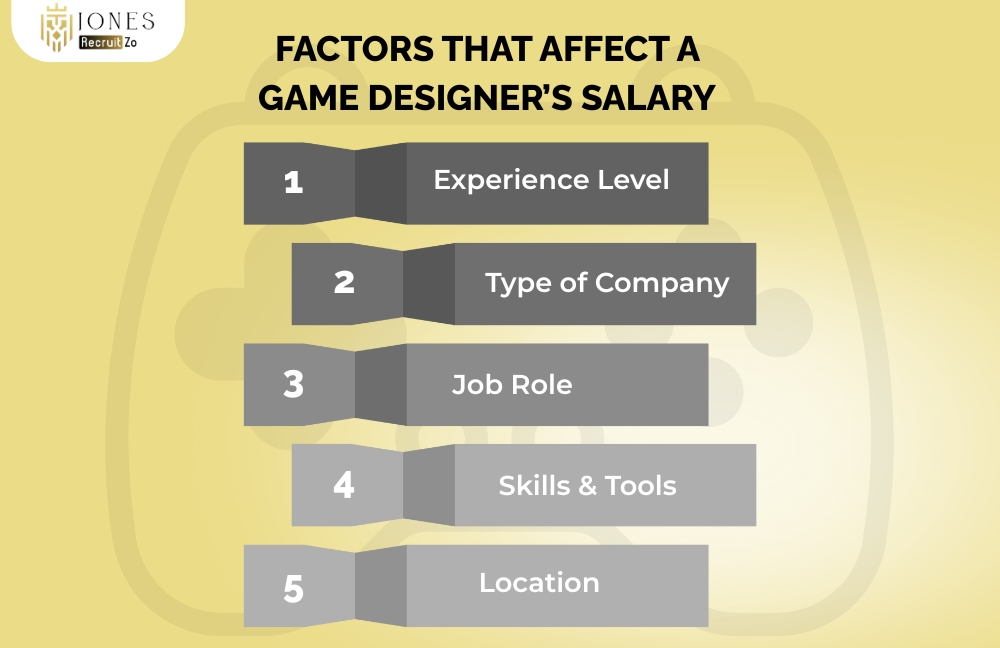
Understanding what influences salary levels helps candidates plan their career development effectively.
Experience Level
The more experience a designer gains, the higher their salary tends to be. Experience means solving difficult design problems, managing people, and understanding gamers, which are important to companies. Also, builders with more skills can do mentoring for the juniors, lead projects, and provide their input through the overall creative strategy, which makes them no less than a necessity for studios.
Type of Company
Salaries for international gaming studios and well-established Indian companies are higher compared with indie startups. Companies with higher cash outlays generally give better perks, exposure, and career growth. In addition, larger firms are usually the ones offering career progression, bonuses, and state-of-the-art technology, thus making them financially rewarding in the long run.
Job Role
A designer’s role is associated with salary directly. Gameplay designers, level designers, UI/UX designers, and narrative designers earn differently based on the demand, specialisation, and technical requirements. Higher creative or technical responsibility roles, such as lead designers or systems designers, usually come with premium compensation.
Skills & Tools
Knowledge of engines like Unity and Unreal, 3D tools, scripting languages, and prototyping skills greatly elevates salary prospects. Game designers showing the combination of technical depth and creativity are likely to become top priority for the fast track. Mastering the new technologies, such as AR/VR, AI integration, or procedural content generation, can also result in drawing the attention of a candidate and thereby increase the hiring potential.
Location
Cities with a mature gaming ecosystem offer higher salaries due to more companies, better infrastructure, and stronger industry demand. Designers in top tech hubs also benefit from networking opportunities, exposure to large-scale projects, and higher living allowances, which contribute to overall compensation.
Tips to Increase Game Designer Salary
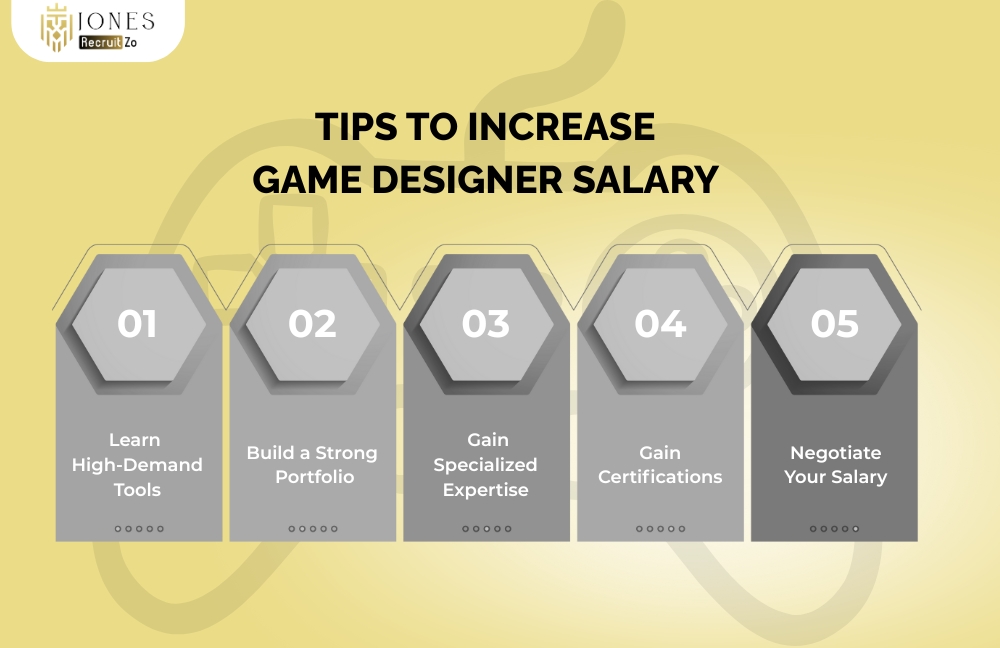
Learn High-Demand Tools
Besides being familiar with standard tools used in the industry, such as Unreal Engine and Unity, and the creative software used for designing, the designer creates an impression that they are ready to take on more skilled tasks. Candidates who are capable of working on difficult projects without the need for considerable training are preferred by the employers. One who stays updated with the latest versions and features of the mentioned tools also proves to be more adaptable and hence, his/her value is increased in the long run. Along with the above-mentioned tools, knowledge of other software like Maya, Blender, or Photoshop can also help in being more versatile and thus, more employable.
Build a Strong Portfolio
If a candidate has a directory of high-quality prototypes, game mechanics, UI samples, and personal game projects, then he/she can enjoy the benefit of competitiveness. It serves as a demonstration of one’s imaginative power and practical ability. Showing the whole process of the project or game demo illustrates the capacity to handle the complete game development process, which is greatly appreciated by recruiters. A well-designed portfolio also provides an opportunity for the designers to demonstrate their abilities in problem-solving, innovation, and meticulousness.
Gain Specialized Expertise
Game designers who focus on niches like combat mechanics, user psychology, level design, or monetisation strategies can earn higher salaries. The specialisation shows that the candidate has deep knowledge of the field and hence, he/she is the first one to be considered for job offers in a highly competitive market. Recognition of one’s expertise in a particular area also serves as a stepping stone towards assuming leading positions, getting consulting opportunities, and being involved in highly rated projects.
Gain Certifications
Recognised platform certifications foster the trustworthiness of a designer and the designer’s comprehension of structured game development processes. Moreover, they indicate to the hiring managers that the designer is committed to professional development and is keeping up with the industry standards. Networking, access to premium resources, and direct endorsements from renowned tutors or organizations are the benefits that some certifications can provide. This mixture of understanding and credibility can greatly aid in negotiating the salary.
Negotiate Your Salary
Job seekers are advised to conduct a thorough study on salary benchmarks, to bring their achievements into the light, and then to express their worth in a professional manner in order to receive better offers. Good negotiation demands to put forth a precise argument for the compensation based on one’s experience, skill set, and the current market rate. Showing previous achievements, giving non-monetary contributions of one’s work in numbers, or having a very rare knowledge can be powerful tools to attract the employer’s interest. Plus, being aware of the complete compensation package—comprising of benefits, bonuses, and perks—helps the designers to negotiate in a broader way and thus, increases their total income.
FAQ
1) What is the average salary of a game designer in India?
In India, the average salary of a game designer is around ₹4–6 LPA for those who are just starting out or are in the middle of their career but it does go up quite a bit with experience and different skills. The salaries also get affected by factors like the city, the size of the company, and the difficulty of the projects that are done.
2) What is the highest salary of a game designer in India?
Top senior and lead game designers in international studios or large Indian game companies can expect to see a compromise of ₹20 LPA and above as the case may be, if the portfolio quality and the expertise are good. Outstanding designers who have rare skills in new technologies like AR/VR or AAA game development might even get more.
3) What are the factors that affect game designer salary in India?
The salary is influenced by experience, the specific role, the type of company, the location, and the technical skills especially in industry-standard tools such as Unity, Unreal Engine, and 3D software. Moreover, a designer’s capability to make an impact with their projects or lead teams may raise their salaries considerably.
4) How much does a game designer earn per month in India?
Game designers have a monthly salary of ₹30,000-₹1,50,000 on average, which varies depending on experience, role, and location. Designers working on a freelance or contract basis can have different incomes every month depending on the number and complexity of the projects they work on.
5) What is the average salary of a game designer in Chennai?
Game designers in Chennai normally receive a salary of ₹3.5–7 LPA, while those with specialized skills and working in the top studios will be taking home higher salaries. A lot of salaries in Chennai are due to the presence of gaming multinationals and IT hubs, thus the city is having more competitive salary packages.